
AP19677938 «Developing a method of predicting the enclosing rock displacement to the earth’s surface for modernizing the technology of the re-development of ore horizons» S. s: D. K. Takhanov
Relevance
Forecasting ground surface subsidence caused by underground mining is a pressing issue in mineral resource development, as ground movement processes can have negative impacts on buildings, structures, engineering utilities, and natural objects located above mined areas. This problem has become particularly significant over the past decade due to the involvement of previously left reserves in protective pillars in secondary mining operations.
Despite the large volume of theoretical and experimental studies devoted to assessing the influence of the condition of structural elements of the applied mining systems and the enclosing rock mass on surface deformation parameters, there is still no definitive scientifically substantiated approach to the effective design of technological parameters for the extraction of ore deposits. The commonly used methods for calculating ground movement parameters are based on the analysis of field observations and the application of empirical relationships developed for specific deposits, which are not always applicable to other similar deposits.
Therefore, the problem of increasing the efficiency of ore deposit development, taking into account the prediction of rock mass movement up to the ground surface in order to ensure complete mineral extraction, is an important practical and scientific task. Its solution makes it possible to reduce the cost per unit of extracted mineral.
Based on the conducted analysis and review of the current state of the problem, the objective of this scientific and applied research has been formulated as the improvement of the technology for secondary mining of gently dipping ore bodies through reliable prediction of rock mass and ground surface movement by studying the governing patterns and identifying factors that determine the boundaries of the deformation zone limited by slip surfaces.
Project Objective
The objective of the project is to improve the technology of secondary mining of gently dipping ore bodies based on reliable prediction of rock mass and ground surface movement by studying governing patterns and identifying factors that determine the boundaries of the deformation zone limited by slip surfaces.
Expected and Achieved Results
The project was completed in full compliance with the 2023–2025 work schedule. A method for predicting the movement of enclosing rock masses up to the ground surface was developed and tested, which was confirmed by an act of pilot-industrial testing and an act certifying the achieved technological readiness level (TRL-6). At the final stage, an improved technological scheme for the secondary extraction of chamber reserves was developed and substantiated, a techno-economic efficiency assessment was carried out, and all necessary technical documentation was prepared. The technology is ready for implementation at mining industry enterprises.
In accordance with the work schedule:
An improved method for predicting the movement of enclosing rock masses up to the ground surface was developed, aimed at modernizing the technology of secondary mining of gently dipping ore bodies. The adequacy of the theoretical solutions was assessed against experimental and field data, confirming the reliability of the proposed methodology. The developed method and the results of its validation are presented in the final project report (IRN AR19677938).
An assessment of the adequacy of the theoretical solutions with respect to experimental data was also carried out, and the feasibility of applying the developed method was substantiated. The developed method for predicting the movement of enclosing rock masses demonstrated high reliability in modeling geomechanical processes accompanying the secondary mining of gently dipping ore bodies. The deviation of calculated values from actual ground surface subsidence parameters does not exceed 10%, which confirms the accuracy of the prediction. Additional verification using a method based on the energy approach (BABO) showed good agreement between the model and field observations, as well as the stability of the subsidence trough geometry during successive extraction of pillars. An advantage of the method is its ability to predict both surface deformations and the internal stress–strain state of the rock mass under various mining layouts. This made it possible to substantiate the feasibility of applying the technology and, based on numerical modeling, to develop an improved technological scheme for the extraction of chamber reserves, ensuring increased recovery and reduced geomechanical risks.
A techno-economic efficiency assessment of the developed technological scheme ensuring complete extraction of mineral reserves from the subsurface was carried out.
Within this stage, a techno-economic evaluation of the improved technological scheme for secondary mining of chamber reserves was performed. The main objective of the assessment was to determine the increase in the recovery factor, the volume of additionally involved reserves, and the magnitude of the economic effect from implementing the technology based on the method for predicting the movement of enclosing rock masses.
The calculations showed that the implementation of the proposed scheme allows for the additional extraction of approximately 49 thousand tons of ore, resulting in an increased recovery factor and an economic effect of about 1.27 billion tenge, achieved through the reduction of losses in pillars and the involvement of previously inaccessible reserves into production.
List of Publications for 2025:
Three (3) articles have been published in journals indexed in the Scopus database:
1. M. Balpanova, G. Sapinov, A. Rymkulova, A. Ospanov, S. Imanbayeva, S. Tyan Research on the stability of mine workings and the risk of rock caving at the Zhaysan deposit, Kazakhstan. Mining of Mineral Deposits, 2025, 19 (3), p. 106-119. https://doi.org/10.33271/mining19.03.106 Scopus 75% (Q1);
2. D. Takhanov, G. Sapinov, M. Balpanova, D. Ivadilinova, M. Zharaspaev, S. Tyan Evaluating Rock Mass Quality and Critical Depth for Rockburst Hazard in Deep Mines. Civil Engineering Journal, 2025, 11 (9), p. 3758-3781. https://doi.org/10.28991/CEJ-2025-011-09-012 Scopus 78% (Q1).
3. D. Takhanov, G. Sapinov, M. Balpanova, D. Ivadilinova, M. Zharaspaev, Z. Abdrasheva Evaluating Rock Mass Quality and Critical Depth for Rockburst Hazard in Deep Mines. Civil Engineering Journal, 2025, 11 (9), p. 3758-3781. https://doi.org/10.28991/CEJ-2025-011-09-012 Scopus 80%.
4. One (1) article has been published in a scientific journal recommended by KOKNVO. Таханов, А.Рымқұлова, Б.Рахметов, М.Балпанова Комплексное применение методов lem и fem для оценки геомеханических рисков. Горный журнал Казахстана №7, 2025 г. С. 30-39. №7, 2025 год. https://doi.org/10.48498/minmag.2025.243.7.007.
Monograph Published:
5. D. Takhanov, A. Zhienbaev, A. Rymkulova. *Innovative Methods for Predicting Ground Surface Subsidence during Secondary Mining of Ore Deposits.* Monograph. Kazakhstan, PEGASO Publishing, 2025. 126 p. ISBN 978-601-82132-6-7
Participation in an International Scientific-Practical Conference with Publication of Research Results: D. Takhanov, A. Rymkulova, B. Rakhmetov. *Comprehensive Application of LEM and FEM Methods for Assessing Geomechanical Risks.* International Scientific-Practical Conference “XVII Saginov Readings: Integration of Education, Science, and Industry,” 2025, pp. 127–129
Patents for 2025:Patent for a Utility Model of the Republic of Kazakhstan: Method for Constructing an Artificial Pillar, No. 10927, dated 28.03.2025.Authors: M. Z. Balpanova, D. K. Takhanov, O. T. Balabayev
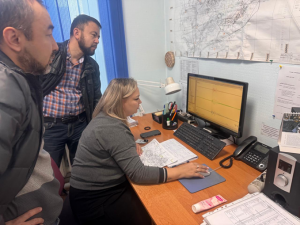
Figure 1 – Joint work of the project AP19677938 team with a representative of the South Zhezkazgan Mine on interpreting seismological monitoring data to refine the forecast of deformation processes.
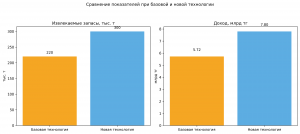
Figure 2 – Comparison of the volumes of extracted reserves and the economic outcome when applying the baseline and the new technological schemes.
Research Team
1. Daulet Kuatovich Takhanov – Project Leader, PhD in Technical Sciences, Assistant Professor, Department of Mining Engineering and Industrial Safety
Hirsch Index: 8
Researcher ID: ABD-4789-2020
ORCID: 0000-0002-2360-9156
Scopus Author ID: 57204771421
2. Merei Zhumagalievna Balpanova – PhD, Lead Researcher
Hirsch Index: 3
Researcher ID: AGM-4593-2022
ORCID: 0000-0002-1513-5317
Scopus Author ID: 57218699653
3. Madiyar Aspandiyarovich Zharaspaev – Researcher, Deputy Head of Geomechanics Department, JSC “Kazakhmys Corporation”
ORCID: 0000-0002-3489-8969
Scopus Author ID: 55363789500
4. Sveta Bakytovna Imanbayeva – Researcher, PhD, Acting Associate Professor, Department of Mining Engineering and Industrial Safety
ORCID: 0000-0002-3489-8969
Scopus Author ID: 57219558896
5. Anar Talgatkyzy Makasheva – Researcher, Engineer, Department of Science and Innovation
Scopus Author ID: 000000000
Web of Science Researcher ID: GYU-0116-2022
ORCID: 0000-0002-0477-0737
6. Araylym Rymkulova – Researcher, PhD in Technical Sciences, Lecturer, Department of Mining and Geology
Hirsch Index: 1
Scopus Author ID: 58476681400
Web of Science Researcher ID: D-3766-2019
ORCID: 0000-0001-9033-8002
7. Bekzad Rozbaevich Rakhmetov – Researcher, Senior Researcher, LLC “Scientific and Technical Center for Industrial Safety”
Hirsch Index: 1
Scopus Author ID: 59245207700
ORCID: 0009-0006-0929-190X
Information for Potential Users
The implementation of the project improves industrial safety in mining operations at enterprises developing gently dipping ore deposits and provides a foundation for introducing a more economical and efficient secondary extraction technology.
The developed method for predicting the movement of enclosing rock masses allows for a justified assessment of geomechanical risks, optimization of chamber and pillar parameters, and increased recovery of mineral resources.
Based on a comprehensive set of theoretical, experimental, field, and computational studies, an improved technological scheme for secondary extraction of ore reserves in pillars has been developed. Its application contributes to reduced losses, increased recoverable reserves, and enhanced overall economic efficiency of deposit development.
Field of Application: Mining Industry
Date of information update: 25.12.2025
AP19675471 “Development of a technology for synthesizing composite ceramic materials of the AlxFeySi system using an additive method”, S. s. – V. A. Andreyachshenko
Relevance:
The use of aluminum alloys has an undeniable advantage over many other alloys, primarily due to their low weight, good performance properties, high electrical conductivity, anti-corrosion properties and sufficient mechanical characteristics. However, to achieve a high level of these characteristics, alloying with expensive, usually rare earth elements, is required. This approach leads to a sharp increase in the cost of finished parts. Ceramics of the MeSi type (silicides) have high hardness and wear resistance. To solve the problem of improving the quality of aluminum-based parts, it was decided to develop a composite ceramic material AlxFeySi. The uniqueness of the material lies in the possibility of forming the Al8Fe2Si phase, which has a highly symmetrical crystal lattice, providing the ability of the resulting composite ceramic materials to perceive plastic deformation.
Project objective:
To develop a technology for synthesizing composite ceramic materials of the AlxFeySi system using an additive method to improve the quality of the structure of materials and parts based on them.
Expected and achieved results:
The properties of the obtained composite ceramic materials were investigated, and numerical characteristics of the mechanical and performance properties of the resulting composite material were determined, including hardness, wear resistance, strength, and ductility. The phase composition was identified, and the resulting microstructure was analyzed. Mathematical models describing the influence of technological conditions on the final properties of the composite were developed.
The microstructure was examined, and numerical characteristics of the mechanical and performance properties of the studied composite material after synthesis, heat treatment, and plastic deformation were obtained, including hardness, wear resistance, strength, and ductility parameters. The alloy composition has a predominant influence on the processability of synthesis, on the fusibility of charge components, and on the quality of the resulting ingots. By selecting a flux for the process, the amount of silicon and manganese in the alloy can be controlled in addition to what is introduced in the charge. The influence of the alloy composition on the temperatures of phase transformations and the conditions for the formation of the α intermetallic phase was identified. It was established that none of the alloying elements increased the volumetric content of the α-phase in the intermetallic alloy with a composition close to that of the α-phase. The main effect of impurity/alloying elements lies in altering the temperatures of phase transitions and features of phase formation, which in turn determine the type and morphology of structural components and the microstructure as a whole. It was found that plastic deformation promotes structural heterogenization with separation of β and θ phases. A particularly strong influence on the level of mechanical properties is exerted by the specifics of phase transformation during cooling, especially the conditions for the solubility of the θ phase and its subsequent precipitation.
Dependencies were developed and tested that describe the influence of temperature, chemical and phase composition, and pre-treatment—taking into account microstructure morphology—on the ductility of the alloy under high-temperature deformation.
As a result of the conducted research, an efficient and reproducible technology was developed for synthesizing AlxFeySi composite ceramic materials using an additive method, ensuring high structural quality, stable mechanical properties, and the possibility of adapting the composition and process parameters to specific technical requirements. Based on the obtained data, recommendations were developed for implementing the synthesis technology of AlxFeySi composite ceramic materials using an additive method to improve the structural quality of materials and components based on them.
Design documentation was developed for the technology of synthesizing AlxFeySi composite ceramic materials using an additive method to improve the structural quality of materials and components based on them. This documentation includes the Technological Section, Synthesis Process Diagram, Operation Route Sheet, Equipment Specification, and Technological Instruction.
 |
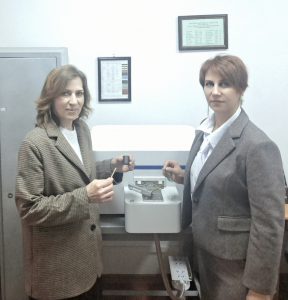 |
Figure 1 – Work of the research group on the study of composite ceramic materials of the AlxFeySi system
Research group
1. Andreyachshenko Violetta Aleksandrovna, PhD, Associate Professor (Associate Professor) in the specialty metallurgy, Head of ILIP “KORMS” –
Hirsch index (Scopus) – 10
Hirsch index (WoS) – 8;
ResearcherID: H-4328-2013;
https://orcid.org/0000-0001-6933-8163;
Scopus Author ID 55308057400
2. Bartenev Igor Anatolyevich, Candidate of Technical Sciences, Associate Professor, Associate Professor of the Department of TOMiS –
Hirsch index (Scopus) – 3,
Hirsch index (WoS) – 2,
Scopus Author ID: 57207457067,
ORCID: 0000-0001-8982-7319
3. Ibatov Marat Kenesovich, Doctor of Technical Sciences, Professor of the department. TTiLS –
https://orcid.org/0000-0001-5062-7790,
ResearcherID: N-9320-2017,
Scopus Author ID: 57189211438,
Hirsch index (Scopus) – 5, Hirsch index (WoS) – 3
4. Alina Arailym Altynbekovna, PhD, senior teacher of the department NTM –
https://orcid.org/0000-0003-3577-4914,
Scopus Author ID: 57218196165,
ResearcherID:DRQ-4173-2022,
Hirsch index (Scopus) – 1, Hirsch index (WoS) – 1.
5. Malashkevichute-Bryan Elena Iozasovna, master, senior teacher of the department NTM –
Scopus Author ID: 5876248370,
Hirsch index (Scopus) – 2, Hirsch index (WoS) – 1
6. Yerzhan Aidana, Master, PhD student in Metallurgy –
https://orcid.org/0000-0002-6942-2020,
Scopus Author ID: 56901129500,
Hirsch index (Scopus) – 1, Hirsch index (WoS) – 1.
7. Tulepova Moldir Abylseitkyzy, Master, PhD student in Metallurgy –
ORCID: 0009-0004-1560-0161
List of publications
1. Andreyachshenko V., Ulyeva G. Heat treatment effect on the intermetallic Al-Fe-Si alloy microstructure // Acta Metallurgica Slovaca. – 2024. – Vol. 30, No. 4. – P. 156–160. – DOI 10.36547/ams.30.4.2092. (Scopus, процентель 52) (не включена в отчет за 2024 год)
2. Andreyachshenko V. A., Toleuova A. R. Effect of boron additive on the formation of ferrous phases in alloys Al-Fe-Si // Material and Mechanical Engineering Technology. – 2025. – Vol. 1. – P. 55–61. – DOI 10.52209/2706-977X_2025_1_55.
3. Андреященко В. А., Бартенев И. А. Способ синтеза металлокерамического материала системы алюминий-железо-кремний с квазиэквиатомным составом: пат. РК 37413 Республика Казахстан. – Опубл. 04.07.2025.
4. Андреященко В.А., Бартенев И.А. Способ получения сплава с интерметаллидным составом «Алюминий-железо-кремний-марганец»: пат. на полезную модель РК 11167 Республика Казахстан. – Опубл. 19.09.2025 г.
5. Андреященко В.А. Особенности легирования и синтеза интерметаллидных алюминиевых сплавов / В.А. Андреященко; НАО «Карагандинский технический университет имени Абылкаса Сагинова». – Караганда: Изд-во НАО «Карагандинский технический университет имени Абылкаса Сагинова», 2025. – 102 с.
6. Andreyachshenko V. A., Ibatov M., Toleuova A. The effect of adding Mn and Cr to the Al-Fe-Si system alloy // Acta Metallurgica Slovaca. – 2025. – Vol. 31, No. 3. – P. 181–185. – DOI 10.36547/ams.31.3.2230. (Scopus, процентель 52)
Information for potential users
The results of the Project are applicable for the manufacture of machine components operating in harsh conditions and subject to intensive wear. The use of the new alloy as a structural material allows for a significant reduction in the weight of finished products (more than 2 times) compared to steel products, while the hardness of the new composite material is higher.
Scope
The scope of application of the Project results is the automotive and mechanical engineering industries. The target consumers of the obtained results will be mechanical engineering and automotive manufacturing enterprises, machine components operating in harsh conditions and subject to intensive wear.
Date of information update: 25.12.2025
AP19680121 “Development of compositions of sand-polymer composite materials and technological support of their processing into machine-building products” – S. s V.V. Yurchenko
Actuality
The project involves the production of products for machine-building and the construction industry, characterized by high profitability (high content of inexpensive filler and the use of thermoplastic polymer waste), increased operational characteristics (compressive strength at least 100 MPa).
Purpose of the project
The purpose of the project is to develop compositions of sand-polymer composite materials, modified with functional components, and technological support of their processing into machine-building products with an increased level of operational characteristics.
Expected and achieved results
Achieved results:
1) It has been established that SPC based on a mixture of polyolefins filled with quartz sand with a dispersion of filler particles in the range of 100…300 μm maintains an acceptable level of strength indicators at the uniaxial compression (at least 25 MPa), if the filler content does not exceed 75 wt.% when deformation of composite samples is not more than 5%.
2) Surface preparation of quartz particles slightly improves the interaction of the polymer binder with the filler, which is manifested in an increase in the compressive strength of the samples by 10-15%, as well as the impact viscosity by 10% within 70-75 wt.% of the content of the quartz filler. A positive effect was noted when introducing nanoparticles of silicon dioxide into the composition of PPK. When the nanomodifier content is no more than 0.1 wt.% (the so-called “doping additive”), an increase in compressive strength of SPC70 samples with treated filler particles is observed by 15% compared to the composition of the original composition.
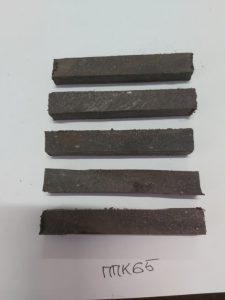
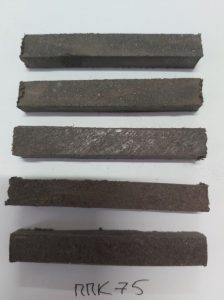
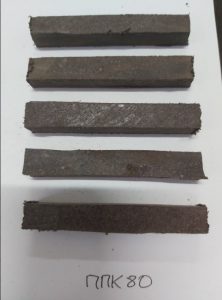
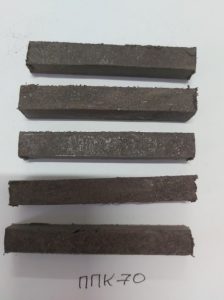
To determine the impact viscosity of sand-polymer composites, samples with different amounts of binder material were made.
|
а) |
b) |
c) |
d) |
f) |
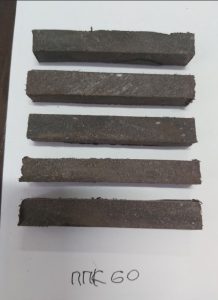
а) SPC 60; б) SPC 65; в) SPC 70; г) SPC 75; д) SPC 80
Figure 1 – Samples of composite materials for determination of impact viscosity indicators
As a result of testing SPC samples under uniaxial compression, the data were obtained within the limits of the fracture resistance of the studied composites (Figure 2).
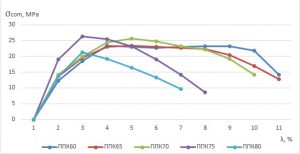
Figure 2 – Deformation-strength dependences during uniaxial compression of PPK samples filled with quartz filler in the range of 60…80 wt.%
List of references
1. Investigation of Strength of Belt Conveyor Roller Bearing Shells. Yurchenko V.V., Smagulov A.S., Reshetnikova O.S., Zharkevich O.M., Mussaev M.M. Material and Mechanical Engineering Technology, №2, 2025
DOI 10.52209/2706-977X_2025_2_80 IRSTI 55.03.03 UDC 681.87
2 Оптимизация рабочего цикла гидравлического ударного механизма с совмещенным органом управления. UDC 622.232 O.S. Reshetnikova, K.B. Kyzyrov, G.S. Zhetesova, V.V. Yurchenko, O.M. Zharkevich, D.A. Ashimbayev, 2025. MINING equipment • ГОРНЫЕ машины ФЕВРАЛЬ, 2025, “УГОЛЬ” DOI: http://dx.doi.org/10.18796/0041-5790-2025-2-93-99. J. Compos. Sci. 2025, 9, 206 https://doi.org/10.3390/jcs9050206
3. Исследование прочности корпуса подшипникового узла ленточного конвейера. UDC 621.82 V.V. Yurchenko, O.M. Zharkevich , O.S. Reshetnikova , G.S. Zhetesova , T.Yu. Maletkina , A.S. Smagulov , 2025. MINING EQUIPMENT • ГОРНЫЕ МАШИНЫ. СЕНТЯБРЬ, 2025, “УГОЛЬ” DOI: http://dx.doi.org/10.18796/0041-5790-2025-9-77-81
Research group
Yurchenko V.V.
PhD, ass. professor, department TOMiS NPJSC “Abylkas Saginov Karaganda Technical
University”
h-index: 4;
ORCHID 0000-0002-6543-1632
Scopus Author ID 57213756780
Zhetessova G.S.
d.t.s., professor department TOMiS NPJSC “Abylkas Saginov Karaganda Technical
University”
h-index: 5;
Researcher ID: S-3369-2017;
ORCID 0000-0001-6504-3405;
Scopus Author ID 57219845188.
Reshetnikova O.S.
PhD, acting associate professor department TOMiS NPJSC “Abylkas Saginov Karaganda
Technical University”
h-index: 2;
Researcher ID: S-3369-2017;
Scopus Author ID 57201777271.
Zharkevich O.M.
c.t.s,professor department TOMiS NPJSC “Abylkas Saginov Karaganda Technical
University”
h-index: 8;
Researcher ID N-9080-2017;
ORCID 0000-0002-4249-4710;
Scopus Author ID 55339344600.
Myssayev M.M.
PhD, associate professor department TOMiS NPJSC “Abylkas Saginov Karaganda Technical
University”
h-index: 4;
Researcher ID: AAR-6997-2020;
ORCID: 0000-0001-9875-8159;
Scopus Author ID: 57220743851
Smagulov A.S.
Doctoral student of department TOMiS NPJSC “Abylkas Saginov Karaganda Technical
University”
ORCID: 0009-0003-1109-185X
Scopus Author ID: 58763311700
Kim A.S.
Engineer of machine tools with CNC CKiPR NPJSC “Abylkas Saginov Karaganda Technical
University”
ORCID: 0000-0001-6282-9998
Scopus Author ID: 59869267300
Altaybekova K.A.
Specialist DSandI departent TOMiS NPJSC “Abylkas Saginov Karaganda Technical
University”
Information for potential users
The project involves the creation of polymer composite systems based on thermoplastic binders, as well as the use of quartz fillers to reinforce binders based on polymer and oligomeric components. The project is focused on the use of the available raw material potential, available to industrial enterprises of the Republic of Kazakhstan and the Republic of Belarus, without the use of imported components of composite polymer systems, including by involving in the production of regenerated polymeric thermoplastic materials based on household and industrial waste.
The target users of the obtained results of the project may be machine-building enterprises, mechanical parks of large and medium-sized enterprises in the mining industry, enterprises – producers of composite materials, enterprises specializing in the processing of secondary raw materials. The applicability of the obtained scientific results is also possible in scientific and project organizations, as well as in higher educational institutions, when teaching bachelors, masters and doctoral students.
Area of application
The field of application technology is quite extensive. Products made of composite materials have a high level of wear resistance and strength with their relative lightness and mobility. The technology implemented as a result can be applied to areas in mechanical engineering and construction, in the creation of military equipment, in cosmonautics and aviation, for the production of consumer goods.
Date of information update: 25.12.2025
№ AP19678770 “Radioecological Aspects of the Radioactivity of Energy Coals and Ash-and-Slag Wastes in the Context of Their Environmental Impact”
S. s – Y.N. Pak
Relevance
The relevance of the research results is associated with the study of the radioecological aspects of the natural radioactivity of energy coals and ash-and-slag wastes in the context of their negative impact on the environment.
The radiation hazard caused by naturally occurring radioactive elements contained in coal is one of the important yet underestimated issues of coal-based power generation in Kazakhstan.
To reduce radiation exposure for personnel and residents living near coal-fired thermal power plants, a systematic monitoring of radioecological safety is required.
The current radiation safety standards are limited only to the radionuclide content in ash-and-slag wastes when used for construction purposes.
Results Achieved in the Second Half of 2025:
During the course of the research, experimental data were obtained and analyzed on the specific activity of natural radionuclides (of the uranium and thorium series, and potassium-40) in ash residues formed during the combustion of coals of various genesis and ash content.
The determination of radionuclide activity was carried out using modern instrumental analytical methods, including gamma spectrometry with semiconductor and scintillation detectors, which ensured high accuracy and reproducibility of the obtained results.
Additionally, radiochemical determination of the contribution of each natural radionuclide’s specific activity in fly ash was performed. This made it possible to quantitatively assess the distribution of radionuclides between solid and gaseous combustion products and to identify patterns of their transition into different fractions of ash-and-slag waste.
A model describing the behavior of natural radionuclides during combustion and forecasting their potential emission into the environment has been established.
List of Publications for the Second Half of 2025
1. Tebaeva A.Yu., Pak D.Yu., Pak Y.N. Natural Radioactivity of Energy Coals and Ash-and-Slag Wastes in the Context of Their Environmental Impact // Geological International Student Summit 2025. Saint Petersburg, 2025, pp. 236–239.
2. Pak D.Yu., Pak Y.N., Tebaeva A.Yu. Nuclear-Radiometric Testing of Coals by Natural Gamma Radiation Spectrometry // Proceedings of the International Scientific and Practical Conference “XVII Saginov Readings. Integration of Education, Science and Production,” Part 2, pp. 690–691, 2025.
Research Team
1. Yuriy N. Pak – Project Supervisor, Doctor of Technical Sciences, Professor
https://orcid.org/0000-0002-0699-6764
Scopus Author ID: 7102674136
ResearcherID: V-8724-2018
2. Dmitriy Yu. Pak – Responsible Executor, PhD in Engineering, Associate Professor
https://orcid.org/0000-0002-7215-7846
Scopus Author ID: 45561507200
ResearcherID: V-8176-2018
3. Serikpai K. Tutanov – Researcher, Doctor of Technical Sciences, Professor:
Scopus Author ID: 6505626495
4. Anar Yu. Tebaeva – Researcher, Senior Lecturer
Scopus Author ID: 57367955300
https://orcid.org/0000-0001-5404-7195
5. Diana A. Ibragimova – Researcher, PhD
Scopus Author ID: 57901957700
https://orcid.org/0000-0002-2588-3028
Information for Potential Users
As a result of the project implementation, new scientific data will be obtained on the distribution of natural radionuclides in coals and ash-and-slag wastes, as well as on the patterns of their behavior.
Studies on the natural radioactivity of coals and ash-and-slag wastes generated during coal combustion in the power industry are essential for fuel and energy enterprises and for government environmental monitoring agencies.
Field of Application
Earth and Environmental Sciences
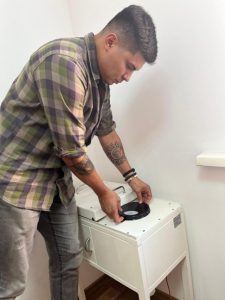
Working with the MKS-01A “MULTIRAD” Spectrometric System |
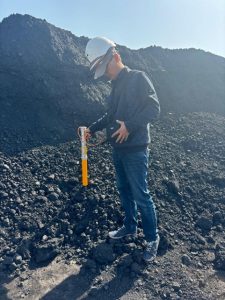
Determination of Natural Radioactivity |
Date of information update: 25.12.2025
AP19675518 “Creation of a pilot industrial prototype of an innovative passenger pneumatic lift for buildings and structures” S. s A.V. Taranov
Relevance
The light passenger elevator market is in need of modernization. In Kazakhstan, 5,000 elevators are in operation that have reached the end of their service life (according to the National Association of Elevator Engineers of Kazakhstan). A similar situation is observed in other CIS markets.
Domestic development of passenger pneumatic lifts solves this problem, providing the safest equipment on the market.
The significant advantages of pneumatic lifts, compared to rope and other types (hydraulic, rack, etc.), are:
– simplicity of design;
– reliability and safety in operation;
– unlimited lifting height;
– reduction of costs for manufacturing, installation and operation;
– a small required excess pressure of compressed air in the subvascular cavity of the shaft creates favorable dynamic conditions for the operation of the pneumatic lift.
The project methodology is based on the theoretical foundations of mechanical and electrical engineering, pneumatic devices and systems, mathematical statistics, methods of measuring and processing experimental results, and methods of specialized software for design work.
As a result, a design documentation package will be developed and a prototype of a pneumatic passenger lift will be manufactured. Potential users of the project include mid- and high-rise residential buildings, business centers, and other administrative buildings. The research team successfully developed the basic operating principle and technical capabilities and tested them on a production-scale pneumatic freight lift.
The development of pneumatic lifts for passengers allows us to offer the market a domestic, export-oriented solution that surpasses its foreign counterparts in terms of performance.
Project goal
The aim of this project is to create a pilot industrial model of a passenger pneumatic lift, as well as design and technological documentation
Results achieved
1. The technology and technical specifications for the design of a passenger pneumatic lift have been developed.
2. An application for a Eurasian patent has been filed
3. Equipment and software were purchased
4. The article was submitted to the Scopus database journal “International review of mechanical engineering»
5. An article was published in the journal “Proceedings of the University” recommended by KOKSON
6. 3 papers presented at international conferences
7. Design and engineering documentation for pilot industrial prototypes of a multi-story passenger pneumatic lift has been developed.
8. Stop devices for stopping the cabin on the corresponding floor and designs of cabin doors and doors on floors with sealing elements have been developed
9. Research, search and selection of materials for sealing devices was carried out
10. A pilot prototype of an innovative passenger pneumatic lift for residential buildings is being manufactured. A factory testing methodology has been developed.
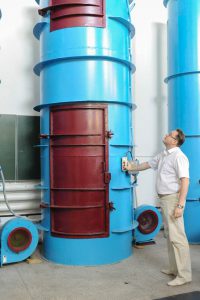
Pilot-industrial prototype of a pneumatic cargo lift for buildings and structures |

Section of the pilot-industrial prototype of a passenger pneumatic lift |
 Manufacturing of a cabin for a pilot-scale passenger pneumatic lift Manufacturing of a cabin for a pilot-scale passenger pneumatic lift |
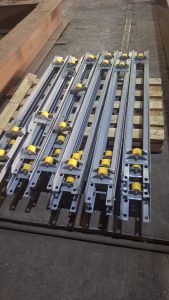 Guide devices of a pilot-industrial model of a passenger pneumatic lift Guide devices of a pilot-industrial model of a passenger pneumatic lift |
 The assembly process of a passenger pneumatic lift with a lifting capacity of up to 640 kgf The assembly process of a passenger pneumatic lift with a lifting capacity of up to 640 kgf |
 Corner fragment of the guide and sealing device in the shaft Corner fragment of the guide and sealing device in the shaft |
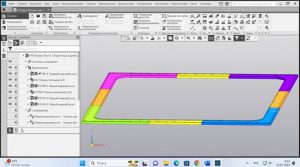 Form for compacting devices Form for compacting devices |
 Compacting device Compacting device |
 Elevator shaft Elevator shaft |
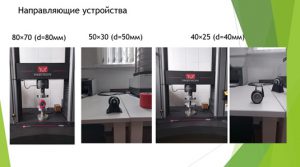 Testing of guide devices Testing of guide devices |
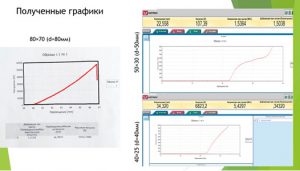 Load charts for guide devices Load charts for guide devices |
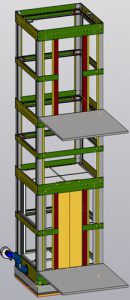
General view of a passenger pneumatic lift with a lifting capacity of up to 640 kg
Information for potential users
Feasibility studies have shown that simplifying the pneumatic lift’s design has reduced manufacturing, installation, maintenance, and operating costs, eliminating construction, installation, and commissioning costs by a factor of two to three (depending on the lift type). This, in turn, makes the pneumatic lift competitive with existing cable and other types of freight elevators, eliminating Kazakhstan’s dependence on foreign suppliers of similar equipment.
Scope of application
The project’s scientific focus is on lifting and transport engineering. Potential customers include mid- and high-rise residential buildings, business centers, and other administrative buildings. The development of pneumatic passenger lifts allows us to offer the market a domestic, export-oriented solution that outperforms foreign counterparts.
Research group
1. Taranov Alexander Viktorovich, Ph.D.,
Hirsch Index 3,
ORCID – 0000-0002-1534-9737,
Scopus Author ID – 56669560400
2. Suleymanov Seidamet Rishadovich, M.Sc. (Eng.), Hirsch index 1,
ORCID – 0000-0001-5753-3789,
Scopus Author ID – 56669831600,
ResearcherID – ADZ-1365-2022
3. Bulatbaev Felix Nazymovich, Ph.D., Associate Professor,
H-index 7,
ORCID – 0000-0002-3574-1189,
Scopus Author ID – 56669831600
4. Baydyusenov Galym Nurzhanovich, M.Sc.,
h-index 0, ORCID 0000-0001-6145-7117,
Scopus Author ID 57541025100
5. Balandin Vitaly Sergeevich, M.Sc.
ORCID – 0000-0002-6593-1864,
Scopus Author ID – 57215332448
6. Kaydanovich Olga Yurievna, M.Sc.,
ORCID-0000-0003-1958-2197
List of publications for the second half of 2025:
1) Taranov A.V., Lukin D.A. Pneumatic lifts. Basic principles of operation, their advantages and application in modern infrastructure. Actual problems of our time: International scientific journal. No. 2 (48) – 2025. – Karaganda: RIO “Bolashak-Baspa”, 2025. – 159 p.
2) Taranov AV, Suleimanov SR, Brazhanova DK, Lukin DA “Study of stress-strain state of guide devices of passenger pneumatic lifts”, International Journal on Technical and Physical Problems of Engineering (IJTPE), Issue 63, Vol. 17, No. 2, pp. 171-177, 2025. https://www.iotpe.com/IJTPE/IJTPE-2025/IJTPE-Issue63-Vol17-No2-Jun2025/20-IJTPE-Issue63-Vol17-No2-Jun2025-pp171-177.pdf
Date of information update: 25.12.2025
AP19678460: “Intensification of scientific and professional language training of STEM specialists in the context of the digital transformation of education”
S. s.: D.D. Jantassova
Relevance
The study aims to enhance the quality of scientific and professional training, aligning educational content with the realities of production. This is a key focus in the higher technical education system. In light of the increasing discrepancy between the standard of professional training and employers’ requirements in the context of digital transformation, it is necessary to update training content, methodologies, technologies and models for training specialists. In this regard, the issue of intensifying scientific and professional language training in the new digital landscape is particularly important.
The relevance of the research topic is determined by the following: 1) the transformation of the technical education paradigm, taking into account the priorities dictated by the knowledge-intensive economy;
2) changes in the requirements for the scientific and professional language training of technical specialists, and the need to integrate this training into the digital educational space;
3) finding ways to intensify scientific and professional language training for technical specialists.
Expected and achieved results:
1. A model of scientific and professional language training was introduced, contributing to the development of a confident command of professionally oriented terminology and analytical and research communication skills in a professional environment. The interdisciplinary nature of the educational process was ensured, enabling students to apply their language and research skills in the context of their future professional activities. Practice-oriented training methods were introduced to strengthen the analytical and research components of educational activities and develop students’ skills in interpreting, visualising, and presenting scientific data.
2. A digital programme for teaching scientific and professional language has been introduced. It comprises eight modules that correspond to the main characteristics of scientific and technical discourse.
-STEM terminology skills
-STEM Meta-Skills: Visualization and Presentation
-Academic writing skills in STEM fields
-Proficiency in the language required for engineering calculations and data analysis
-Language proficiency in the engineering design process
-Research skills in STEM fields
-Academic citation and ethical reasoning
3. A pedagogical experiment was conducted, including a comparative analysis of the indicators of the experimental and control groups. A sustained positive trend in student performance, motivation, and independence was confirmed, indicating an increased interest in and awareness of the practical orientation of the learning process.
The effectiveness of the model and its positive impact on the assimilation of scientific and linguistic learning material were confirmed. Integrating modern digital technologies into the learning process contributed to developing students’ professional, communication and research competencies.
List of publications:
Monograph
D.D. Jantassova, Zh. A. Azimbayeva. Scientific discourse in professional and technical communication: monograph / D.D. Jantassova, Zh.A. Azimbayeva. – Almaty: Abylkas Saginov Karaganda Technical University, 2025. – 229 p. – ISBN 978-601-1234-56-7.
Chapter in a foreign publication:
Jantassova D., Azimbayeva Zh., Aitbayeva S. Language, Literature and Education: Research Updates / Book Chapter in International Book: BP International Publishing House (India &UK), 2025. ISBN 978-81-990550-3-2 (eBook). DOI: https://doi.org/10.9734/bpi/lleru/v7
Skopus database article:
Jantassova D., Hockley A. David, Kaliaskarov N., Azimbayeva Zh.. Research Proficiency of Engineers: Analysis of the Mass Survey. TEM Journal. 2025.-Volume 14, Issue 2, pages 1303-1312, ISSN 2217-8309, DOI:10.18421/TEM142-31 https://www.temjournal.com/content/142/TEMJournalMay2025_1303_1312.html
CQASHE journals’ article:
1) Jantassova D., Damiyev D. Design of the framework for stem language training in engineering education // Higher education in Kazakhstan, 2025. -№2 (50). DOI:10.59787/2413-5488-2025-50-2-5-17
2) Jantassova D., Tentekbayeva Zh., Damiyev D. Defining the linguistic means of scientific and technical communication in the training of engineers // Higher education in Kazakhstan, 2025.- №3 (51). DOI:10.59787/2413-5488-2025-51-3-74-915.
Conference thesis:
Zh. A. Azimbayeva, A.Kishenova Tools and results for determining the level of scientific style in language subjects in the academic environment // Proceedings of XVII Integration of Education, Science and Production’. Integration of Education, Science and Production (three volumes of Sagynov Oculars). Karaganda Technical University, Karaganda: KarTU Publ., 2025.– 265 p. https://www.kstu.kz/wp-content/uploads/2025/07/1-chast.pdf
RSCI database article:
Jantassova D.D., Azimbayeva Zh.A., Yurchenko V.V. Development of measures for scientific and linguistic training of STEM specialists // Information and Communication Technologies in Pedagogical Education, 2025. No. 4 (97). p. 48–53.
https://elibrary.ru/item.asp?id=82453828
CIO
1) Jantassova D.D., Tentekbayeva Zh. M., Damiev D.T. Digital programme for teaching scientific language in the professional training of STEM specialists. Certificate of entry in the state register of rights to objects protected by copyright (No. 59883 of 17 June 2025). https://copyright.kazpatent.kz/?!.iD=wQEy
2) Jantassova D.D., Tentekbayeva Zh.M., Aitbayeva S.Kh. Model of scientific and professional language training for specialists in technical fields. Certificate of entry in the state register of rights to objects protected by copyright (No. 59599 of 11 June 2025). https://copyright.kazpatent.kz/?!.iD=wQEy
Research group
1. Jantassova Damira Dulatovna – scientific supervisor, head of Foreign Languages’ Department, Abylkas Saginov Karaganda Technical University, PhD (Pedagogical Sciences),
ORCID ID: 0000-0003-2595-3249,
Researcher ID P-7271-2017,
Scopus Author ID 57189027014
2. Azimbaeva Zhanat Amantaevna – researcher, Head of the Department of Russian Language and Culture, Abylkas Saginov Karaganda Technical University, Senior Lecturer,
ORCID ID: 0000-0002-9247-1138,
Scopus Author ID: 55990394300
3. Kaliaskaraov Nurbol Baltabaevich – researcher, Head of the Technologies of the Communication Systems Department, PhD,
ORCID ID 0000-0003-3684-14205,
Scopus Author ID: 57201113007,
Researcher ID Web of Science: ABC-2155-2020,
Researcher ID in Publons: ABC-2155-2020
4. Yurchenko Vasiliy Viktorovich – researcher, senior teacher, Abylkas Saginov Karaganda Technical University, PhD,
ORCHID 0000-0002-6543-1632,
Scopus Author ID 57213756780
6. Kishenova Ainur Yusupovna – researcher, senior teacher, Department of Russian Language and Culture, Abylkas Saginov Karaganda Technical University,
ORCID ID 0000-0002-1494-6388,
Researcher ID 23774690
7. Tentekbayeva Zhuldyz Mukhamedgaliyevna – researcher, p.s.m., senior teacher, Foreign Languages’ Department, Abylkas Saginov Karaganda Technical University, Researcher ID: GYD-4656-2022,
ORCID ID: 0000-0002-9286-0352,
Scopus Author ID: 56027539800
8. Aitbayeva Saltanat Khamzakyzy – researcher, p.s.m., teacher, Foreign Languages’ Department, Abylkas Saginov Karaganda Technical University,
ORCID ID: 0000-0002-7511-952X
9. Damiyev Daniel Temirgalievich – researcher, t. s. m., senior laboratory assistant, of Foreign Languages’ Department, Abylkas Saginov Karaganda Technical University,
ORCID ID 0000-0002-4245-6810

Interface of the digital program for teaching scientific language in STEM fields
|
|
|
|
|
|
|
|
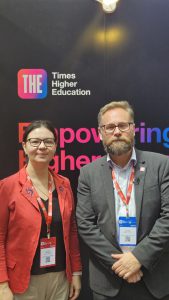
Meeting with Phil Baty, Chief Global Affairs Officer. Times Higher Education and prof. Jantassova D., Saginov Technical University |
 Modules of digital program (portal)
 Module 2 Academic writing skills in STEM fields
 Integration with AI for academic writing verification
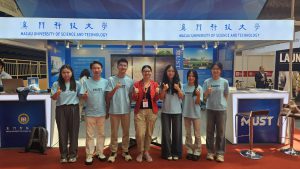 Participation of project research team members in the Times Higher Education Asian Universities Summit and meetings with scholars and students from the University of Science and Technology of Macau (MUST), China (April 22-24, 2025)
Information for potential users
The project’s implementation has enabled the introduction of a scientific and professional language training model for technical specialists into the teaching of second and foreign languages to technical students, with a focus on intensifying scientific and linguistic activity through digital technologies.
The developed model for intensifying the scientific and linguistic training of STEM specialists comprises a range of pedagogical, methodological and digital solutions designed to develop students’ academic and professional foreign language communication skills, which are essential for participation in scientific research, the preparation of publications and the presentation of the results of scientific and project activities.
Potential users of the project results are:
•technical higher education institutions;
•students of technical higher education institutions and colleges;
•manufacturers and miners who want to improve their scientific language skills in engineering and processing;
•language departments that train students in engineering and technical fields, as well as specialists in professional communication;
•digital learning centres.
Scope of application
The results of the project can be used in higher professional education systems on implementing technical education programmes that include the study of second and foreign languages. The developed model of scientific and professional language training for technical specialists using digital technologies can be implemented:
in the educational process of technical universities to develop the scientifically oriented communication and language skills of students;
in the system of additional professional education and advanced training for teachers of language and professional disciplines at technical universities;
in the development of electronic educational resources, online courses, and digital platforms for language training for students of technical specialities;
in the scientific and methodological activities of departments and centres that provide language training for specialists in high-tech industries.
Date of information update: 25.12.2025
AP19680292 “Development of an expert system for decision-making on the issues of fastening and support of mine workings”.
S. s: A.N. Tomilov
Relevance:
The main difference of the software product being created is the use of both heuristic and algorithmic methods, which allows for the most optimal query results.
The expert system’s knowledge base contains rules (or other representations of knowledge) that are used as a basis for decision-making. The inference engine contains general knowledge about the problem-solving framework. This engine consists of two components: an interpreter and a dispatcher. The interpreter determines how to apply the rules to infer new knowledge, while the dispatcher controls the order in which the rules are applied. The knowledge base editor is used to modify the expert system’s rules and add new knowledge to the system.
The purpose of the project
The purpose of the project is to create a domestic expert system aimed at presenting solutions to the issues of fastening and maintaining mine workings using both heuristic and algorithmic methods, which allows to give the most optimal result of requests. The placement of the knowledge base and the main software of the expert system is expected to be carried out using cloud technologies.
Expected and achieved results
The main result of the project is the creation of a domestic expert system aimed at providing solutions for the support and maintenance of mine workings using both heuristic and algorithmic methods. The use of cloud technologies is proposed for the placement of the knowledge base and the main software of the expert system. The result of using the expert system will be the proposal of optimal parameters of various types of support for any cross-sections of mine workings, parameters and methods of mine workings protection, determination of destruction zones in the vicinity of mine workings, taking into account the change of mining and geological and mining and technical conditions of mining deposits of minerals, taking into account the time factor, allowing to determine the expected displacements and loads. The modular structure of the expert system allows for further expansion to solve a wide range of geomechanics problems. The expert system has been tested in collaboration with specialists from third-party scientific organizations to ensure the adequacy of the decisions made. The correct operation of the expert system has been confirmed.
The expert system test report and the conclusion on the expert system’s readiness for trial operation have been received. Testing has been conducted with the participation of «KAZPROM AVTOMATIKA» LLP
Experimental operation of the expert system. An act of experimental and industrial tests of the system has been received. Experimental and industrial tests have been conducted with the participation of Scientific and Technical Center Alternative LLP. A license agreement for the use of the expert system has been developed.
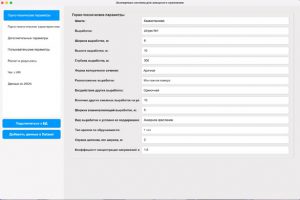
Figure 1 – Input module |
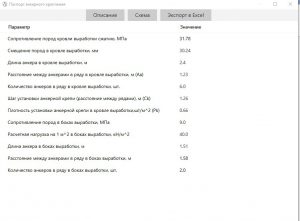
Figure 2 – Numerical Simulation Module |

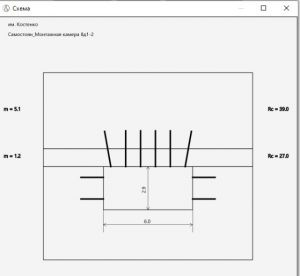
Figure 3 – Machine Learning module
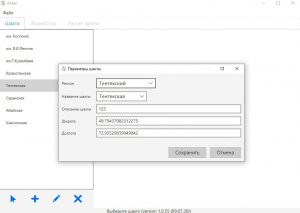
Figure 4 – Knowledge Base module |
Input module: a system block where all the initial data about the array structure, development conditions, and technical characteristics of the production are entered.
A numerical modeling module is an element of a system that takes initial parameters, such as geology, geomechanics, design solutions, and loads, and conducts a computational experiment
A machine learning module is an intelligent “prediction organ” that learns from past situations to capture patterns that are difficult to detect in pure physics.
Over time, such a module becomes especially valuable, because every new production and every measurement becomes an experience for it.
Knowledge base module — If you think of a system as a living structure, the knowledge base is its long-term memory.
Information for potential users
Expert system for the support and maintenance of mine workings can be useful for anyone working or conducting research in the field of mining and underground construction, providing analytical data on rock formations, assessing the stability of mine workings, and developing methods for their maintenance. Enterprises specializing in the construction of mines, tunnels, underground structures, and mining facilities can use the system to develop and implement optimal methods for support and maintenance. The system provides users with not only information and recommendations, but also tools for making informed decisions, which helps to improve the safety, efficiency, and reliability of mining and construction projects.
Application area
Application area: mine surveying and geotechnical services of mining enterprises, allowing for the adoption of decisions on the support and maintenance of mine workings in a short time on the basis of empirical and algorithmic methods. The normative methods of calculation of mine workings support parameters included in the knowledge base ensure compliance with all safety rules for mining operations adopted in the Republic of Kazakhstan.
The Research Group
1. Tomilov Alexander Nikolaevich – Scientific Supervisor, PhD, Head of the Laboratory of the Department of Information and Computer Science.
Hirsch Index – 3
ORCID ID 0000-0002-0491-1640
Scopus ID 57201117035
2. Kalinin Alexey Anatolyevich – Executive Officer, PhD, Head of the Department of Information and Computer Science. Hirsch index -4 ORCID 0000-0003-4699-7240 Scopus Author ID 57193550259
3. Demin Vladimir Fedorovich – Dr. of Engineering, Professor of the Department of RMPI.
Hirsch index – 8.
ORCID ID: 0000-0002-1718-856x.
Scopus ID: 57212219714.
4. Tomilova Nadezhda Ivanovna – PhD, Associate Professor of the Department of Information and Computer Science.
Hirsch Index – 2
ORCID ID: 0000-0001-8782-5627;
Scopus ID: 57194212148
5. Mutovina Natalya Viktorovna – Ph.D., Senior Lecturer of the Department of Information and Computer Science.
Hirsch Index – 2
Scopus ID: 57218196942
ORCID ID: 0000-0002-8116-9507
Researcher ID Web of Science: ABC-3961-2020
6. Smagulova Asemgul Serikovna – Ph.D., Senior Lecturer of the Department of Information and Computer Science.
Scopus Author ID: 57216143249
Researcher ID: AGX-6097-2022
ORCID ID: 0000-0003-1534-1644
7. Stefan Kirill Borisovich – M.T.S., Head of the Software Center.
Hirsch Index – 1
ORCID 0000-0003-3174-7214
8. Nurtay Margulan Dauituly – PhD, Lecturer at the Department of Information and Computer Science.
Hirsch Index – 1
Scopus ID 57216143287
List of publications and forthcoming publications
1. Tomilov A., Kalinin A., Tomilova N., Nurtay M., Mutovina N., Shtefan K., Zhumagulova D. Expert System for Stability Assessment of Underground Excavations Based on Numerical Modeling and Engineering Rules. Applied Sciences 2025, Quartile Q1, percentile 69. https://www.mdpi.com/2076-3417/15/16/8951
2. Natalia Viktorovna Mutovina; Asemgul Serikovna Smagulova; Vladimir Fyodorovich Demin; Alexander Nikolaevich Tomilov. Optimization of the Parameters of Anchor Support of Mine Workings, Taking into Account Factors of Operating Conditions: Analysis of the Mines of the Karaganda Coal Basin. // University Proceedings – No. 1 (98), 2025, pp. 183-191. DOI: 10.52209/16091825_2025_1_183.
3. Certificate No. 59921 dated June 18, 2025, issued to Asemgul Serikovna Smagulova, Alexey Anatolyevich Kalinin, Natalya Viktorovna Mutovina, and Alexander Nikolaevich Tomilov for a computer program titled “Program for Calculating the Effect Obtained by Extracting an Enlarged Whole.”
Date of information update: 25.12.2025
AP19678453 “Institutional regulation of the prevention of interethnic conflicts among student youth in the context of the socio-cultural transformation of Kazakhstani society”
S. s Shormanbaeva D.G.
Relevance
For Kazakhstan, one of the most multicultural and multiethnic societies in the modern world, interethnic communication is not just a term or a category for academic research, but a vital component of civilizational security. Modern Kazakhstan has emerged as a diverse society, and at the beginning of the 21st century, it continues to address issues of integrating ethnic groups into the Kazakh political nation.
Kazakhstan’s progress toward a new quality of life along the path of global civilization is impossible without internal stability and consolidation, as well as the preservation and strengthening of interethnic harmony at all levels of relations. The paradigm shift in our country’s development along these lines is outlined in Head of State Kassym-Jomart Tokayev’s Address to the People of Kazakhstan, “New Kazakhstan: The Path of Renewal and Modernization.” This project aims to facilitate the implementation of Objective 1, “Development of Kazakhstan’s Identity and Intellectual Potential,” of the National Project “Ulttyk Ruhani Zhangyru.”
Student youth represent a socio-demographic group in the process of developing socio-cultural and civic maturity. Their low engagement in social relations and the persistence of the attitudes and stereotypes of the previous generation lead to a tendency toward identification and isolation, conformism, and negativity. Therefore, special attention must be paid to interethnic interaction among young people.
This research focuses on preventing interethnic conflicts in Kazakhstan through institutional regulation mechanisms, which we believe is one of the most effective ways to foster tolerant attitudes, solidarity, and mutual respect.
Results achieved in the second half of 2025:
1) A control mechanism was developed for the indicators identified during the experiment and the effectiveness of the tools was determined
The development of a control mechanism for the indicators identified during the experiment is based on an analysis of the university’s core processes, existing approaches, and principles for implementing diversity policies and preventing interethnic conflicts. Five strategies have been identified, highlighting control mechanisms for the indicators identified during the experiment:
1) Strategy 1 – institutionalization of the policy of tolerance and non-discrimination will allow the formation of a regulatory framework;
2) Strategy 2 – educational integration of intercultural competence will ensure educational integration;
3) Strategy 3 – creating a space for dialogue and trust will strengthen the practice of dialogue and trust;
4) Strategy 3 – early warning and mediation system will ensure the effectiveness of the prevention and response mechanism;
5) Strategy 5 – digital and cultural multilingual environment, will ensure the creation of a multilingual digital environment.
2) Monitoring of the influence of educational and upbringing factors, the level of intrapersonal conflict on the formation of ethnic identity, and a decrease in the level of interethnic tension among young people in the experimental group was carried out.
The aim of the study at this stage was to monitor the influence of educational and upbringing factors, as well as the level of intrapersonal conflict on the processes of formation of ethnic identity and reduction of the level of interethnic tension in the experimental group of youth.
To ensure an in-depth analysis of the developed criteria and the influence of factors, the monitoring was divided into two stages:
1 Organization of events and evaluation according to developed criteria.
2 Formation of groups of standardized indicators with assignment of a code to each factor.
During the research the following tasks were solved:
– the indicators of ethnic identity of young people (cognitive, emotional-value, behavioral components) were determined;
– the degree was revealedintrapersonal conflicts among participants in the experimental group;
– The influence of educational and upbringing factors (training courses, supervisory work,extracurricular projects) on the dynamics of ethnic identity;
– The level of interethnic tension in the experimental group was monitored.
The object of monitoring was student youth in the context of the educational process at the university.
The subject is the influence of educational and upbringing factors, as well as the level of intrapersonal conflict on ethnic identity and interethnic tension.
In accordance with the developed control mechanisms, a list of measures to record performance was determined.
A comparative analysis of methods and tools was carried out, and the optimal option was selected for monitoring the influence of educational and upbringing factors, the level of intrapersonal conflict on the formation of ethnic identity, and the reduction of the level of interethnic tension among young people in the experimental group.
Based on the identified control mechanisms for the experimental indicators, a guide for the second stage of monitoring the influence of educational and upbringing factors, the level of intrapersonal conflict on the formation of ethnic identity, and the reduction of the level of interethnic tension among young people in the experimental group was developed.
The goal of the second stage of monitoring was defined: to assess the dynamics and cause-and-effect relationships between the formation of ethnic identity and the level of interethnic tension and:
– educational factors (mentoring, training, training modules);
– educational factors (involvement inextracurricular activities);
– levelintrapersonal conflict (tension, cognitive dissonance, identity difficulties).
Monitoring provides the basis for adjusting programs and early intervention within the framework of developed strategies.
A number of recommendations have been developed to improve the effectiveness of the toolkit.
List of publications for the 2nd half of 2025.
Shebalina O., Smirnova G., Gabdullina K. Youth Socio-Cultural Capacity Development through the professional education // Asian Journal of University Education, 2025. – Volume 21, Number 3. – R. 972-983 (77 percentile)ajue.uitm.edu.my/wp-content/uploads/2025/10/64-Olga-Youth-Socio-Cultural-Capacity.pdf (https://doi.org/10.24191/ajue.v21i3.64)
Research group
1. Shormanbaeva D.G. scientific supervisor, PhD,Head of the Department of APKSHD,
Scopus Author ID 56073522400;
ORCID= 5607-3522-400
2. Smirnova G.M. responsible executive, candidate of pedagogical sciences, associate professor of the department APKSHD,
Scopus Author ID 57208045259
ORCID= 0000-0003-2980-8700
3. Gotting V.V. PhD, Associate Professor of the Department APKSHD
Scopus Author ID 57189024743,
ORCID= 0000-0002-0490-7289
4. Sharipova R.M. senior lecturer of the department APKSHD
ORCID= https://orcid.org/0000-0002-0526-3278
5. Shebalina O.A. PhD,Head of the Center for Sustainable Development
Scopus Author ID 57207845776,
ORCID https://orcid.org/0000-0001-7641-2528
6. Tusupbekov Zh.A. senior lecturer of the department APKSHD
Scopus Author ID 57219244724,
ORCID https://orcid.org/0000-0002-5885-5082
7. Amirov A.Zh. PhD, Dean of the Faculty of Information Technology
Scopus Author ID 57204729952;
ORCID= 0000-0002-5895-7185
Information for potential users
The resulting data can be used and useful for civil servants in the internal policy departments of regional, city, and district akimats of the Republic of Kazakhstan, who are responsible for developing and implementing state programs and initiatives in the area of interethnic relations. The research findings will also be useful for the heads of ethnic cultural centers operating within the Assembly of the People of Kazakhstan, which promote the cultural traditions and values of various ethnic groups and their integration into public life. Furthermore, these materials can be used by youth wing leaders, who play a key role in fostering tolerance and mutual understanding among young people, as well as by those responsible for educational work at universities and colleges, to implement the principles of interethnic harmony and unity in the educational environment.
Scope of application
The results obtained can be used to regulate the prevention of interethnic conflicts among student youth and will form the basis for the implementation of state initiatives to build a Just State based on the culture, solidarity, and creativity of citizens, especially youth.
Date of information update: 25.12.2025
AR19679505: Research and Development of Multi-Threshold Decoding Algorithms for Convolutional Codes and Their Software-Hardware Implementation for High-Speed Fading Radio Channels. S. s: Zhuldyz Sailaukyzy
The relevance of the research is linked to the implementation of the objectives set by the state program “Digital Kazakhstan”, the Law of the Republic of Kazakhstan “On National Security”, and the State Cybersecurity Concept “Cyber Shield of Kazakhstan”, which aim to ensure the information security of the national information and communication infrastructure and to maintain and develop an effective system for protecting information resources and communication infrastructure.The development of a national radio communication system is a crucial component of national and information security, as it ensures connectivity between special government agencies, the Armed Forces, law enforcement bodies, emergency medical services, fire brigades, and search and rescue teams.
Currently, high-speed and reliable radio communication systems are implemented using orthogonal frequency-division multiplexing (OFDM) technology, which ensures the required spectral efficiency and high data capacity. However, in broadband wireless communication over long distances, a large number of errors occur, making it necessary to apply forward error correction (FEC) methods. The main idea of the project is to develop and implement effective software-hardware error correction schemes for use in fading radio communication networks, especially under conditions of Doppler shift and inter-symbol interference.
The aim of the project is to investigate and develop error correction methods and tools that enable operation close to the channel capacity when applied in rapidly changing digital radio communication systems. This includes integration with technologies such as orthogonal frequency-division multiplexing (OFDM), high-order modulation schemes, space-time coding, and precoding.
Achieved Results in the Second Half of 2025
Software tools and testing methodologies for software and hardware implementations of multi-threshold decoding in radio communication systems were developed. Channel modeling algorithms were created, test data were prepared, and a software–hardware test bench was built to conduct comprehensive experimental studies. The performance of multi-threshold decoders was evaluated in terms of noise resilience, computational latency, and throughput under various operating conditions. The experimental results confirmed the operability of the developed solutions and the effectiveness of the applied testing methods. The outcomes of the research were published in national and international scientific journals, as well as in the proceedings of an international scientific conference.
Software, technical, and design documentation for the developed software and hardware solutions was prepared, including descriptions of the system architecture, functional modules, and operating conditions. Legal protection of the intellectual property generated during the project was completed. The software for parallel implementation of error-correction systems based on PyOpenCL was officially registered and confirmed by Certificate No. 56400 dated April 3, 2025. Additionally, an electronic educational manual titled “Foundations of Error-Resilient Coding and Multi-Threshold Decoding” was created and registered under Certificate No. 63227 dated October 21, 2025, enabling its integration into the educational process. The involvement of young researchers in the project was ensured. PhD candidate Еgamberdiyev Е.U. completed the research related to the project and prepared his dissertation, the defense of which is scheduled for December 4, 2025.
|
|
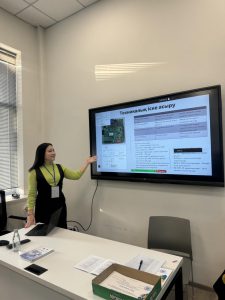 |
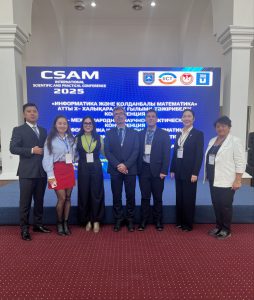
Participation of the project leader Zh. Sailaukysy in the 10th International Scientific and Practical Conference “Informatics and Applied Mathematics” (Almaty, 2025) with the presentation “Hardware Implementation and Performance Analysis of Multi-Threshold Decoding Methods in Radio Communication Systems.”
List of Publications for the Second Half of 2025
1. Nurlan Tashatov, Gennady Ovechkin, Zhuldyz Sailaukyzy, Eldor Egamberdiyev, Dina Satybaldina, Gulmira Danenova, Zarina Khassenova. Performance Evaluation of Software Multi-Threshold Decoders for Self-Orthogonal Codes in Modern Broadband Wireless Communication Systems. IJACSA, Vol. 16, No. 11, 2025. (Scopus, Q3).
https://thesai.org/Downloads/Volume16No11/Paper_34-Performance_Evaluation_of_Software_Multi_Threshold_Decoders.pdf
2. Zhakina M.M., Sailaukyzy Zh., Rysbekkyzy B., Egamberdiyev E.U., Amanov A.N. Performance Analysis of LDPC Decoders for Reliable Data Transmission in Noise-Resistant Environments. KazTBU Bulletin, No. 28, 2025, pp. 23–34.
https://doi.org/10.58805/kazutb.v.3.28-976
3. Sailaukyzy Zh., Satybaldina D.Zh., Khasenova Z.T., Egamberdiyev E.U. Hardware Implementation and Performance Analysis of Multi-Threshold Decoding Methods in Radio Communication Systems.
Proceedings of the 10th International Scientific and Practical Conference “Informatics and Applied Mathematics”, Almaty, 2025, pp. 345–352.
https://conf.iict.kz/wp-content/uploads/2025/10/collection_CSAM_2025-2.pdf
4. Egamberdiyev E.U., Satybaldina D.Zh., Sailaukyzy Zh. Parallel Implementation of Error-Correction Systems for Radio Communication Channels Based on PyOpenCL.
Certificate of State Registration No. 56400, issued on April 3, 2025.
5. Sailaukyzy Zh., Khasenova Z.T., Satybaldina D.Zh., Egamberdiyev E.U. Electronic Textbook “Fundamentals of Error-Resilient Coding and Multi-Threshold Decoding”.
Certificate of State Registration No. 63227, issued on October 21, 2025.
Research Team
1. Zhuldyz Sailaukyzy – Project Supervisor, PhD, Acting Associate Professor, Department of Cybersecurity and Artificial Intelligence, Abylkas Saginov Karaganda Technical University (KarTU)
ORCID: 0000-0001-7605-7634
Scopus Author ID: 57440117200
2. Gulmira Tulendievna Danenova – Senior Researcher, Candidate of Technical Sciences, Associate Professor, Department of Cybersecurity and Artificial Intelligence, KarTU
H-index: 1
ORCID: 0000-0003-3301-7282
Scopus Author ID: 57140638000
3. Zarina Toleubekovna Khasenova – Senior Researcher, PhD, Dean of the School of Computer Science, D. Serikbayev East Kazakhstan Technical University (EKTU)
H-index: 2 (Scopus), 1 (WoS)
Scopus Author ID: 57205141835
4. Makhabbat Meiramkyzy Kokkhoz – Senior Researcher, Candidate of Pedagogical Sciences, Associate Professor, Department of Cybersecurity and Artificial Intelligence, KarTU
H-index: 3
Researcher ID: P-6669-2017
Scopus Author ID: 56646533000
ORCID: 0000-0002-6232-1868
5. Dina Zhagiparovna Satybaldina – Senior Researcher, Candidate of Physical and Mathematical Sciences, Associate Professor, Department of Information Security, L.N. Gumilyov Eurasian National University (ENU)
Researcher ID: P-1120-2014
Scopus Author ID: 57193740669
ORCID: 0000-0003-0291-4685
6. Murat Galiaskarovich Kozhanov – Researcher, Master of Technical Sciences, Head of the Department of Cybersecurity and Artificial Intelligence, KarTU
ORCID: 0000-0002-5310-9953
Researcher ID: P-1134-2014
Scopus Author ID: 55946377700
7. Eldor Ulugbekovich Egamberdiev – Researcher, Director of LLP “Adal Damu”
Researcher ID: K-5417-2013
ORCID: 0000-0001-5289-6580
Scopus Author ID: 57196402736
8. Madina Maulenkyzy Zhakina – Junior Researcher, Department of Cybersecurity and Artificial Intelligence, KarTU
9. Aidos Nurlanovich Amanov – Junior Researcher, Department of Cybersecurity and Artificial Intelligence, KarTU
Information for Potential Users
The implementation of this project on the development of error correction tools for radio channels contributes to the advancement of next-generation wireless networks and the application of adaptive telecommunication systems that ensure high reliability in data transmission over variable-parameter radio channels.
Application Area
Applicability and/or commercialization potential of the obtained scientific results: The expected scientific outcomes can be used to modernize communication systems in organizations responsible for national security and defense of the Republic of Kazakhstan, improving the reliability of information transmission.
Date of information update: 25.12.2025