
Department of Radio Electronics and Telecommunication Technologies
The history of the Department of Radio Electronics and Telecommunication Technologies dates back to 1997, when a newly established higher education institution for the Central Kazakhstan region — the Karaganda Institute of Systems Engineering and Business — was engaged in training specialists with higher education in full-time and part-time modes. Training was conducted in relevant and modern specialties such as “Automation, Telemechanics and Communication (by industry)”, “Software and Hardware of Computer Systems and Networks”, “Automatic Telecommunications”, and “Public and Municipal Administration”. The institute was established in December 1996 under the auspices of Karaganda State Technical University with the permission of the Ministry of Education and Science of the Republic of Kazakhstan.
The purpose of establishing the institute was to carry out educational activities in fundamentally new engineering and technical specialties that had not previously been offered at KarSTU. As the only non-state technical higher education institution in the region, the institute operated on a full self-financing basis, providing training commissioned by enterprises, organizations of the region, and individuals.
In 1997, KarSTU withdrew from the founders of the Institute of Systems Engineering and Business, and in 1998, by order of the Rector of Karaganda State Technical University, the institute was incorporated into the educational and methodological complex of KarSTU.
The first head of the institute was Professor, Doctor of Technical Sciences, Academician of the International Academy of Informatization (IAI), M. R. Nurguzhin.
Since September 2000, the Karaganda Institute of Systems Engineering and Business has been headed by Associate Professor, Candidate of Technical Sciences, Corresponding Member of the IAI, N. A. Daniyarov.
The main contingent of part-time students consisted of employees of the Karaganda Regional Telecommunications Directorate — a branch of Kazakhtelecom JSC — as well as the Karaganda Transportation Division of Kazakhstan Temir Zholy JSC, which confirms the relevance of training specialists in these areas within the higher education system of Central Kazakhstan.
The institute maintained stable ties with regional economic entities. In particular, branches of the Department of Specialized Disciplines were established at the Karaganda Regional Telecommunications Directorate and the Karaganda Signaling and Communication Division. In addition, an agreement on educational and methodological cooperation was concluded with the leading university in the republic in the field of communications and telecommunications — the Almaty Institute of Energy and Communications.
In August 2002, new rules for licensing educational activities were introduced by a Resolution of the Government of the Republic of Kazakhstan. In this regard, the Academic Council of KarSTU decided to incorporate the institute into KarSTU and to establish the Faculty of Communications and Telecommunications.
By decision of the Academic Council of Karaganda State Technical University dated September 8, 2002, the Faculty of Communications and Telecommunications was established on the basis of the Institute of Systems Engineering and Business. Associate Professor, Candidate of Technical Sciences N. A. Daniyarov was appointed Dean of the Faculty.
On September 1, 2004, due to changes in the list of specialties in accordance with the new classifier and the optimization of the organizational structure, the Faculty of Communications and Telecommunications was dissolved, and the Department of Radio Electronics and Telecommunication Technologies was incorporated into the Electromechanical Faculty.
Over the years, the Department has been headed by: Candidate of Technical Sciences, Associate Professor N. A. Daniyarov (2002–2006), G. A. Boyko (2006–2008), Candidate of Technical Sciences G. Sh. Orazgaliyev (2008–2009), Candidate of Technical Sciences A. A. Aikeeva (2009–2010), Candidate of Technical Sciences A. D. Mekhtiev (2010–2016), PhD V. V. Yugay (2016–2022), and since 2022 to the present — PhD N. B. Kaliaskarov.

Academic Staff of the Department of Radio Electronics and Telecommunication Technologies (2025–2026)
Senior Lecturer G. N. Mashrapova; Candidate of Technical Sciences, Associate Professor S. T. Alimbayev; Senior Lecturer G. A. Belik; Head of Laboratories S. K. Nygimetzhanova; Senior Lecturers: Candidate of Technical Sciences T. B. Zhakibekov and N. Yu. Bek; Head of the Department of Radio Electronics and Telecommunication Technologies, PhD N. B. Kaliaskarov; Senior Lecturers O. V. Aldoshina and E. A. Sarsembayev; Lecturer M. A. Zhumanbetova; Lecturer Zh. E. Zhaksylyk; Senior Lecturer M. R. Gavrilova; Engineer D. N. Garifullinova; Senior Lecturers A. S. Zhanasbayeva, S. Zh. Sakenova; Assistant B. E. Abdykenova.
The Department of Radio Electronics and Telecommunication Technologies provides bachelor’s degree training in the field of “Communications and Communication Technologies” under the following educational programs:
6B06201 “Radio Engineering, Electronics and Telecommunications” and 6B06202 “Network Technologies and Communication Systems”.
Graduates of this program are qualified to work in all sectors of the national economy that utilize:
• communication networks and communication systems;
• multi-channel telecommunication systems;
• radio communication systems and devices, including radio relay, satellite, and mobile communications;
• audio and television broadcasting systems and multimedia equipment;
• electronic systems, including computer-based control systems for information transmission, processing, and display;
• information security systems for telecommunication networks and infrastructures.
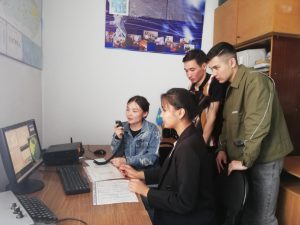
Communication Session at the Collective HF Radio Station
Currently, 190 students are enrolled at the Department in the field of “Radio Engineering, Electronics and Telecommunications”.
A significant contribution to the training of specialists throughout the long history of the Department has been made by: Candidate of Technical Sciences, Associate Professor N. A. Daniyarov; G. A. Boyko; Candidate of Technical Sciences G. Sh. Orazgaliyev; Candidate of Technical Sciences A. A. Aikeeva; Candidate of Technical Sciences A. D. Mekhtiev; PhD V. V. Yugay; PhD N. B. Kaliaskarov; as well as telecommunications veterans — specialists of Kazakhtelecom JSC: V. P. Kim, V. I. Eyrikh, and E. A. Sarsembayev.
Since November 2007, a collective HF radio station UN7PWA has been put into operation at the Department. Its activities are supervised by V. I. Mishchenko, Director of the Karaganda Regional Branch of the Kazakhstan Federation of Radiosport and Amateur Radio.
To date, tens of thousands of radio contacts have been conducted, including participation in international competitions.
Students of the Department regularly take part in radio communication competitions on shortwave and ultra-shortwave frequencies. The collective radio station is actively used in the educational process. In the future, it is planned to conduct space radio communications with the International Space Station (ISS).
The student team of the Department also participates in the Kazakhstan Championships in orienteering.
The Department’s laboratories are equipped with modern educational equipment.
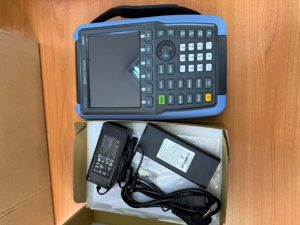
Spectrum Analyzer “HSA870”

Bambu Lab P1S Combo 3D Printer (with AMS, EU version)

Educational Laboratory Mechatronics Module with Automated Sorter and Radio-Frequency Identification (RFID) Tags

Thermal Imaging Camera for Building Temperature Monitoring
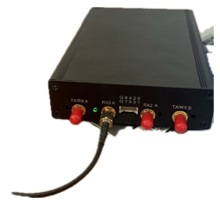
Educational Laboratory Equipment: Software-Defined Reconfigurable Radio Device

MikroTik RBLHGG-60ad Radio Link, Set of 2 Units
Including the opening of two network academies:
In 2019, the Cisco Academy began its operations. The Cisco Networking Academy is an educational program for training IT specialists, available to educational institutions and students in 170 countries worldwide.
The Cisco Networking Academy offers courses for training in the most in-demand areas of the IT world. The academy is equipped with 10 computers, three Cisco Catalyst 2911 routers, two Cisco Catalyst 2960 switches, an IP phone, and wireless access points
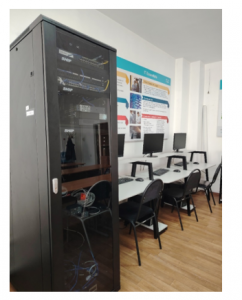
Cisco Networking Academy
In the Cisco Networking Academy courses, students study the fundamentals of building local area networks, IP addressing, switching and routing protocols, network scaling, and more. Upon successful completion of the final examination session, students are awarded a course completion certificate by Cisco Networking Academy instructors.
In 2021, the Huawei ICT Academy was established at the Department of Radio Engineering and Telecommunication Technologies. The Huawei ICT Academy is an international educational cooperation program that prepares highly qualified specialists in the field of information and communication technologies. In Kazakhstan, this program has been operating since 2013. After certification at the Academy, graduates of the department have the opportunity to undertake internships at enterprises both domestically and abroad. Classes are conducted in a specialized Huawei Academy laboratory equipped with all the necessary technical and software resources.
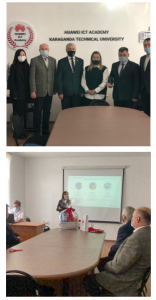
Opening of the Huawei ICT Academy
The establishment of ICT Academies is one of the strategic priorities of the department. Creating all the necessary conditions for training highly qualified specialists is an important step in improving the IT sector and advancing the digitalization of the national economy. The certified instructor of both the Cisco Networking Academy and the Huawei ICT Academy is the Head of the Department of Radio Engineering and Telecommunication Technologies, PhD N. B. Kaliaskarov.
In March 2025, a new Virtual Reality (VR) laboratory was opened at the department. The grand opening ceremony was attended by the university administration, faculty members, students, and alumni of the department. Among the distinguished guests were members of the Board: Vice-Rector for Academic Affairs Bekbolat Rakhishevich Nussupbekov, Vice-Rector for Science and Innovation Ali Djavanshirovich Mekhtiyev, and Vice-Rector for Strategic Development and Digitalization Timur Yerbolatovich Kanapyanov.
The new laboratory has become not only an important component of the educational process but also provided a strong impetus for research activities. The VR laboratory of Abylkas Saginov Karaganda Technical University serves as a new platform of opportunities, enabling students to gain deeper knowledge of telecommunication systems and to work on innovative projects.
In March 2026, a ceremonial opening of the Ruijie Networking Laboratory took place at the department. The event was attended by members of the Board, including Vice-Rector for Digitalization Azamat Amirov, Vice-Rector for Social and Educational Work Abay Kalykov, Director of Barlau Global Distribution LLP Ksenia Gadzhieva, as well as representatives of partner companies such as Kazakhtelecom JSC, TTK, Cosmos Group, and the faculty of the Department of Radio Engineering and Telecommunication Technologies.
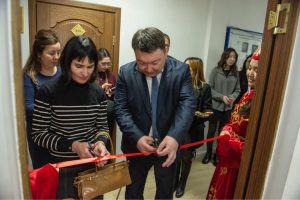

During the event, the importance of opening the networking laboratory at the department was highlighted, along with the relevance of the equipment used both in the educational process and in industrial applications.
The opening of the laboratory became possible благодаря the sponsorship support of Barlau Global Distribution LLP, which assisted in acquiring modern telecommunications equipment. This plays a significant role in developing the university’s educational infrastructure, expanding students’ practical opportunities, and forming the professional competencies of future specialists.
Ruijie Networks is a leading Chinese manufacturer of networking equipment and integrated telecommunications solutions. The company offers modern switches, routers, Wi-Fi access points, and network security systems. Ruijie solutions are designed for the corporate sector, data centers, and the SMB segment (Ruijie Reyee line), including free cloud management, remote configuration via a mobile application, and self-organizing network technologies.
Based on the agreement on the establishment of a Corporate University and a cooperation contract, a memorandum has been signed, and close collaboration is being carried out with Kazakhtelecom JSC.
The department’s partners in organizing summer industrial and pre-graduation internships include the following enterprises: Kazakhtelecom JSC, Transtelecom JSC, Optinet LLP, QazNetworkSolutions LLP, Asia Bell JSC, Karaganda Transtelecom JSC, OLDIMAX LLP, Cosmos IE, and Focus On LLP.
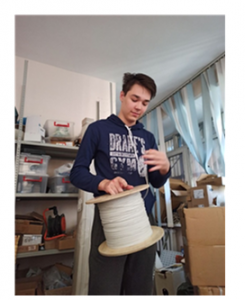 During Industrial Internship
The department conducts research activities in the following areas:
— improvement of communication technologies and systems;
— next-generation measurement systems based on optical sensors;
— enhancement of the technical level of structural components of electromechanical equipment;
— object recognition and handling systems based on robotic manipulators;
— energy saving and energy efficiency of renewable energy sources.
The department has established the Center for Working Professions (CWP) “Improvement of Communication and Telecommunication Systems,” which provides training in two areas: “Fiber Optic Cable Splicer” and “Line Communication Electrician.”
The CWP integrates and consolidates educational resources (training and laboratory equipment, educational and methodological, informational, human, and other resources that ensure the training of highly qualified skilled workers), enabling their shared use.
The CWP is equipped with a fiber optic splicing installation complex with a set of measuring and diagnostic equipment, a laboratory complex “Set of Materials for Building a Network Model from Station to Subscriber,” a “Data Transmission Trainer” stand KL-900A, and an “Optical Fiber Data Transmission System” KL-900D.
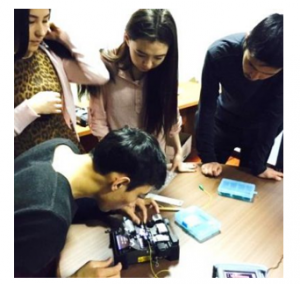
Conducting Practical Classes at the Center for Working Professions (CWP)
For the further development of the department, it is planned to implement targeted training of several Doctor of Philosophy (PhD) candidates through education at leading universities of the country, such as M. Kozybayev North Kazakhstan University, Almaty University of Power Engineering and Telecommunications named after G. Daukeyev, K. Satbayev Kazakh National Research Technical University, and others.
A memorandum was signed between two universities — Abylkas Saginov Karaganda Technical University (NLC) and Tomsk State University of Control Systems and Radioelectronics (TUSUR, Tomsk, Russia). The Department of Radioelectronics and Communication Systems of TUSUR and the Department of Radio Engineering and Telecommunication Technologies of Karaganda Technical University agreed to establish a joint double-degree interuniversity educational program in the field of “Radio Engineering Means of Signal Transmission, Reception, and Processing.” The best students are selected for participation in the program based on their academic and personal achievements, and the academic semesters are synchronized. The memorandum has already come into effect: six students of the RET-23-2 group successfully passed the entrance exams and, since September 2024, have been enrolled in the dual-degree program.
In 2025, a Master’s degree program was launched at the Department of Radio Engineering and Telecommunication Technologies under the educational program 7M07110 — “Radioelectronic Systems and Devices for Detection, Navigation, and Control.”
The objective of the educational program is to train qualified specialists capable of developing, researching, and applying radioelectronic systems used in detection, navigation, and control tasks, as well as to develop research competencies for work in scientific, technical, and industrial fields.