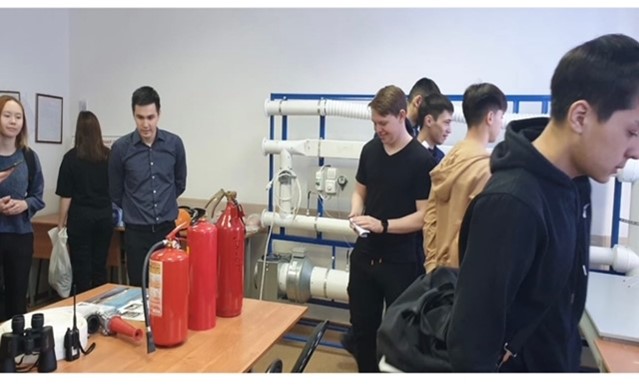
The department of «Industrial Safety and Environmental Science»
Educational Programme 6B11201 «Life Safety and Environmental Protection»
Academic degree: Bachelor in Services
Programme Aim
The aim of Educational Programme 6B11201 «Life Safety and Environmental Protection» is to train professionals who can organise work to ensure life safety and environmental protection requirements at industrial enterprises and other organisations.
Key Programme Objectives
- Apply the principal provisions of the Constitution and legislation of the Republic of Kazakhstan and understand the interaction between substantive and procedural law in public relations and professional practice, including anti-corruption activities.
- Perform calculations when designing and organising production processes.
- Organise production processes with due regard to the relevant physical and chemical phenomena.
- Analyse and plan the business activities of economic entities and participate in their implementation.
- Use cognitive and linguocultural competencies to solve professional tasks.
- Develop design documentation for technical facilities.
- Organise risk management systems for occupational health and safety at industrial enterprises and other organisations.
- Organise fire safety risk management systems at industrial enterprises and other organisations.
- Organise industrial safety risk management systems at hazardous production facilities.
- Organise risk management systems for civil defence and emergency situations at industrial enterprises and other organisations.
- Organise environmental risk management systems at industrial enterprises and other organisations.
Potential Career Paths for Graduates
— occupational health and safety specialists and inspectors;
— industrial safety specialists;
— specialists in public authorities responsible for emergency management, fire safety, and occupational health and safety;
— specialists in environmental public administration bodies, including regional departments of ecology and the authorised national environmental authority;
— specialists in natural resources and environmental management departments;
— environmental design specialists in environmental consultancy and design organisations;
— industrial safety design specialists;
— environmental laboratory technicians and environmental monitoring specialists;
— environmental and occupational health and safety managers;
— environmental specialists at enterprises in various sectors of the economy.
Educational Programme 7M11201 «Life Safety and Environmental Protection»
Academic degree: Master of Technical Sciences in «Life Safety and Environmental Protection»
Programme Aim
The aim of Educational Programme 7M11201 «Life Safety and Environmental Protection» is to train professionals with a high level of professional culture and an active civic outlook who can formulate and solve contemporary scientific and practical problems, teach in higher and postgraduate education institutions, and undertake research and management activities. The programme develops research competencies, supports participation in academic events at various levels, prepares students for further doctoral study subject to the applicable admission requirements, and provides knowledge and teaching experience in higher education pedagogy and psychology.
Key Programme Objectives
— conduct educational activities in higher and postgraduate education institutions in accordance with psychological and pedagogical principles;
— address psychological issues arising in management activities;
— apply research methodology, experimental design methods, and the fundamentals of error theory in professional research;
— lead the development and implementation of creative ideas in professional practice;
— engage in intercultural communication in industrial, research, and teaching activities;
— analyse risk management systems for civil defence and emergency situations;
— analyse the reliability of technical devices and equipment in order to assess the risk of failures, incidents, and accidents during technological processes;
— analyse technological risk management systems and evaluate the effectiveness of risk reduction measures;
— assess the completeness and adequacy of requirements for the safety of technological systems;
— analyse occupational risk management systems at industrial enterprises;
— monitor and analyse working conditions across different industrial sectors;
— assess the completeness and adequacy of ergonomic requirements for production equipment, workplaces, and controls.
Skills Acquired During the Programme
During the programme, master’s students acquire skills in:
— applying general scientific methods in research;
— presenting research findings in various forms of academic output;
— conducting teaching activities;
— using foreign languages in professional, research, and teaching activities.
Programme Delivery
In addition to the activities listed above, priority career areas for graduates of the scientific and pedagogical track include teaching in technical and vocational, higher, and postgraduate education institutions and conducting scientific and technical research.
Study may be funded through the state educational order or on a tuition-fee basis in accordance with the modes of study and educational pathways approved by the University.
Master’s-level training may be offered through professionally oriented and scientific and pedagogical tracks. The duration of study is determined by the number of academic credits, the approved educational programme, and the applicable national requirements.
Admission to master’s programmes is competitive and is based on comprehensive testing in accordance with the current admission regulations of the Republic of Kazakhstan and the University.
Graduates of the scientific and pedagogical track who successfully complete the master’s programme may continue their studies at doctoral level, provided that they meet the applicable admission requirements.