
AP25794755 «Development of methods for monitoring and predicting the destruction of substation structural elements from electrochemical corrosion» S. s: Aitpayeva A.R.
Project Objective
To establish the regularities governing the formation of the stress–strain state of a coal–rock mass located between a geological discontinuity and a mine working driven along an outburst-prone seam, in order to identify zones of loss of rock mass integrity and, on this basis, to improve outburst-prevention measures and enhance the safety of mining operations in coal mines.
Relevance
At present, coal mining in the Karaganda Basin is associated with the intensification of mining operations, increasing depths of extraction, more complex mining and geological conditions, and the development and implementation of new technological solutions.
The mining of highly gas-saturated coal seams in the Karaganda Basin is complicated by gas-dynamic phenomena. Currently, the greatest hazard to miners is posed by sudden coal and gas outbursts, due to the insufficient understanding of their nature and the limited capability for reliable prediction. The risk of injury to personnel working underground is further exacerbated by the potential reversal of the fresh air flow and the gas contamination of mine workings at the panel, district, and entire mine levels.
All recorded sudden outbursts in the Karaganda Basin have occurred within zones of geological discontinuities and disturbed coal. This is primarily explained by the fact that coal seams prone to sudden coal and gas outbursts are characterized by a complex structure and the presence of low-strength layers with tectonic disturbance and crushing that are difficult to predict, which reduces their stability. Practice shows that only about 10% of geological discontinuities intersected by mining operations are outburst-prone; however, the advance prediction of such discontinuities at the geological exploration stage is possible in no more than approximately 15% of cases. Therefore, the problem of forecasting tectonically disturbed zones is undoubtedly relevant for mines developing outburst-prone seams.
Expected Results
The development of a methodology based on the results of the conducted studies, which will be used to formulate and propose amendments to specific provisions of the Instruction for the Safe Conduct of Mining Operations in Seams Hazardous with Respect to Sudden Coal and Gas Outbursts, particularly those concerning the driving of preparatory workings outside the zones of regional pre-treatment of especially outburst-prone seams.
The proposed methodology will enable the technical services of mining enterprises to optimize the planning and execution of mining operations, taking into account the time factor.
Research Team
Scientific Supervisor
Aitpayeva Arailym Rymbekovna
Web of Science ResearcherID: ACD-8801-2022
https://orcid.org/0000-0003-1366-073X
Scopus:
https://www.scopus.com/authid/detail.uri?authorId=57219372423
Scientific Consultant
Khuanghan (Huanghan) Nurbol
Web of Science ResearcherID: ABC-6048-2020
https://orcid.org/0000-0001-9609-6649
Scopus:
https://www.scopus.com/authid/detail.uri?authorId=57191875943
List of publications
1. Исабек Т.К., Хуанган Н., Айтпаева А.Р., Шаймерденова Р.Т., Моделирование выбросоопасного состояния массива с дизъюнктивным нарушением и горной выработкой методом конечных элементов Уголь, г. Москва, 2020, №6. Стр.55
http://www.ugolinfo.ru/index.php?article=202006055
DOI: http://dx.doi.org/10.18796/0041-5790-2020-6-55-61 (Scopus – процентиль 31%)
2. Айтпаева А.Р., Мазах Б.,Исабек Т.К., Противовыбросные мероприятия при разработке угольных ластов в карагандинском угольном бассейне Журнал «Труды университета». № 2(49), 2018 г. – С.43-45
https://www.kstu.kz/tu/2018/trudy_universiteta_2.pdf
3. Айтпаева А.Р., Т.К. Исабек, Р.Р. Ходжаев, И.А. Филатов, К вопросу связи внезапных выбросов с геологическими нарушениями угол ьных пластов Горный журнал Казахстана, г. Алматы, №6, 2018 г.
http://minmag.kz/ru/archive_dates/2018-год/?lang=ru_RU
4. Айтпаева А.Р., Исабек Т.К. , Хуанган Н., Мероприятия по предотвращению выбросоопасности угольных пластов в зонах геологических нарушений Вестник ВКГТУ: Научный журнал. – Усть-Каменогорск: ВКГТУ им. Серикбаева, 2019. – №1. – С. 68-71.
Раздел: Науки о земле и географические науки
https://www.ektu.kz/files/vestnik/geo1_2019.pdf
5. Айтпаева А.Р., Хуанган Н., Исабек Т.К., Уалкан Е.А. Предотвращение выбросоопасности угольных пластов в зонах геологических нарушений путем гидродинамического воздействия на массив через скважины с поверхности Труды Университета. – Караганда: КарГТУ, 2019. – № 1. – С. 48-53.
https://www.kstu.kz/wp-content/uploads/2019/10/TU-3-2019.pdf
6. Айтпаева А.Р., Турганбаев Ж. О., Исабек Т. К. Ведение работ при труднообрушаемой кровле Труды Международной научно-практической конференции «Интеграция науки, образования и производства – основа реализации Плана нации» (Сагиновские чтения № 9), 22-23 июня 2017 г. – С. 269-271.
7. Айтпаева А.Р., Досбол Н.,Портнов В.С. Определение влаги, зольности и выхода летучих веществ угля Сборник материалов Х Международной научно-практической конференции «Геология в развивающемся мире» (ПГНИУ, г. Пермь, 18-21 апреля 2017 г.): – С. 53-54
8. Досбол Н., Айтпаева А.Р., Портнов В.С. Ведение работ в зонах геологических нарушений Сборник материалов Х Международной научно-практической конференции «Геология в развивающемся мире» (ПГНИУ, г. Пермь, 18-21 апреля 2017 г.): – С. 74-75
9. Айтпаева А.Р., Ж.О.Турганбаев, Т.К. Исабек Региональные мероприятия по борьбе с внезапными выбросами угля и газа. Труды XXII Международного симпозиума имени академика М.А. Усова студентов и молодых учёных, Том 2, Томск, Россия, 2018 г. – С. 528-529.
10. Айтпаева А.Р. Методологический подход к формированию решений по предотвращению выбросоопасности угольного пласта в зоне геологических нарушений. Труды Международной научно-практической конференции «Интеграция науки, образования и производства – основа реализации Плана нации» (Сагиновские чтения № 10), 14-15 июня 2018 г. – С. 23-26.
11. Исабек Т.К., Айтпаева А.Р. Механизмы возникновения внезапных выбросов угля и газа Труды Международной научно-практической конференции «Интеграция науки, образования и производства – основа реализации Плана нации» (Сагиновские чтения № 10), 14-15 июня 2018 г. – С. 26-28.
12. Ергенгул Ш., Айтпаева А.Р., Исабек Т.К. Формирование выбросоопасных зон в углепородном массиве и способы предотвращения выбросоопасности на шахтах Труды Международной научно-практической конференции «Интеграция науки, образования и производства – основа реализации Плана нации» (Сагиновские чтения № 10), 14-15 июня 2018 г. – С. 121-124.
13. Айтпаева А.Р., Хуанган Н. Механизм формирования выбросоопасной газодинамической зоны. XXIII Международного научного симпозиума студентов и молодых ученых имени академика М.А. Усова
«Проблемы геологии и освоения недр», Сборник XXIII симпозиума, Том II, 2019 Секция 16. – С. 469-170.
14. Айтпаева А.Р., Исабек Т.К., Воробьев А.Е. Геологиялық бұзылыстар аймағында көмір мен газдың кенеттен тұтануының пайда болуын зерттеу. V Международной научно-практической конференции УДК 622.853.455.
«Science and education in the modern world: challenges of the xxi century» материалы V Международной науч-прак. конф. (Науки о земле)/ сост.: Е. Ешім, Е. Абиев – Нур-Султан, 2019. – С. 50-52
15. Свидетельство авторского права № 63322 от «23» октября 2025 года. Айтпаева Арайлым Рымбековна, Хуанган Нурбол. Название объекта: Геомеханический характер проявлений газодинамических явлений в зонах геологических нарушений
The scope of application.
Mining Engineering, Geology
Date of information update: 25.12.2025
АР25794035 «Development and research of a method for cleaning cutting fluid with ultrasound for its reuse» S.s. Kim A.S., lecturer, department of TEMEandS
Relevance:
In mechanical engineering, metal cutting processes employ metalworking fluids (MWFs) to reduce friction between the workpiece and the cutting tool, thereby minimizing deformation during machining, extending tool life, and increasing productivity.
The service life of working MWF solutions typically ranges from two weeks to three to six months. After this period, if not properly regenerated, the fluids are discarded and directed to costly disposal and neutralization technologies. Under current environmental conditions, MWF disposal constitutes a major ecological challenge for modern mechanical engineering. The washing away of oils from machine guideways (when MWF is supplied to the cutting zone) transforms almost all types of fluids used into hazardous, oil-containing industrial waste.
There exist various MWF cleaning methods—such as flotation, filtration, and treatment in force fields. However, these regeneration methods have several disadvantages, including low productivity and cleaning efficiency, high labor intensity, and structural complexity. Therefore, developing a new method free from these limitations is of high relevance.
Results achieved in the second half of 2025:
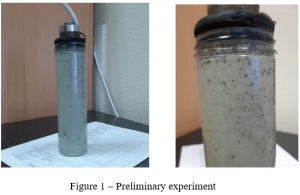
An analysis of existing methods for MWF purification, patent and invention review, and a study of the physical processes involved in ultrasonic cleaning (cavitation, coagulation, and sedimentation) were conducted. Dependencies for calculation methodology were obtained, describing these processes under ultrasonic exposure. A preliminary experiment was conducted (Figure 1). Preparation is underway for an article submission to a journal indexed in the Scopus database with a CiteScore percentile of at least 50. One article was published in a peer-reviewed domestic journal recommended by the Committee for Quality Assurance in Education and Science (KOKNVO).
List of publications for the second half of 2025:
Kim A.S., Mateshov A.K., Savchenko N.K., Shakirova Y.K. Overview of Monitoring Methods for Metalworking Fluids. Material and Mechanical Engineering Technology, No. 2, 2025. DOI: 10.52209/2706-977X_2025_2_94.
Research team:
Project Leader – Kim A.S.
Scientific Consultant – Kadyrov A.S.
Information for potential users:
As a result of the project, a methodology for calculating operating parameters and designing equipment for MWF cleaning will be developed. Deterministic dependencies will be established to determine the required ultrasonic power and energy consumption for MWF treatment, as well as correlations between the cleanliness of the MWF and its electrical resistance. Cleaning from biological contamination will be performed, and an experimental prototype of the device will be developed.
Field of application:
Potential users of the developed and implemented MWF regeneration methodology are all enterprises engaged in mechanical engineering production.
Date of information update: 25.12.2025
AP25795323 «Thermal Energy Distribution Management System» S.s. D.K. Brazhanova
Relevance
The proposed system enables organizations that effectively utilize renewable thermal energy sources and secondary heat sources for operational needs to supply surplus thermal energy to consumers. The development of digital thermal power interfaces for bidirectional communication between thermal energy consumers and neighboring facilities and/or district heating networks is envisaged in order to provide heat supply facilities with the characteristics of active thermal energy consumers (prosumers). The main advantage of the proposed system lies in its ability not only to consume thermal energy from an external source for heating purposes, but also to transfer excess thermal energy to external consumers. This can be implemented either through a centralized district heating network or via local connections to neighboring facilities experiencing a demand for thermal energy.
Project Goal
The objective of the project is to develop a thermal energy distribution management system that ensures the allocation of surplus thermal energy generated from the use of renewable energy sources, as well as the utilization of secondary low-grade heat, with the aim of improving the efficiency of heat supply to consumers.
Research Group
Scientific Supervisor — Brazhanova D.K., Scopus Author ID: 57220805586, ORCID: 0000-0002-1241-6279.
Scientific Consultant — Stoyak V.V., Scopus Author ID: 57192171253, ORCID: 0000-0001-9230-2433.
Field of Application
The proposed system enables organizations efficiently using renewable and secondary thermal resources to transfer excess thermal energy to third-party consumers. This solution falls within the field of thermal power engineering and can be applied for heat supply to residential, industrial, and other types of buildings and facilities.
Project Tasks:
1. Define requirements for the thermal energy distribution management system;
2. Develop operational principles for the system, ensuring appropriate parameters and environment;
3. Model the thermal energy distribution system using the HOMER PRO software suite;
4. Evaluate the effectiveness of the developed system.
Date of information update: 25.12.2025
AP25794755 «Development of methods for monitoring and predicting the destruction of substation structural elements from electrochemical corrosion» S.s. Voitkevich S.V.
The goal of the project is to develop a methodology for monitoring and predicting the destruction of substation structural elements due to electrochemical corrosion, including a model of current distribution across the elements of the substation’s power grid structure, which allows forecasting the intensity of electrochemical corrosion.
Annotation.
The power grid infrastructure is a complex system that includes all the necessary components for the transmission, distribution, and consumption of electrical energy. This system plays a key role in the electric power industry and ensures the energy security of the state. Substations, as an essential part of the power system, perform the functions of voltage transformation, regulation, and distribution of electrical energy.
To ensure electrical safety, all elements of the power grid structures (cables, reinforced concrete poles and foundations, equipment supports at substations, pipelines, artificial grounding devices, etc.) must be grounded, forming a unified grounding system. During the operation of electrical installations, changes often occur in these grounding systems due to violations of their integrity caused by the impact of electrochemical corrosion on grounding elements. This leads to changes in the corrosion environment at the facility, such as a sharp increase in anodic currents at the points of damage to the aluminum sheaths of cables, which in turn reduces their service life.
The safe and reliable operation of power grid facilities is crucial for the stable functioning of the entire electric power system. Effective operation of these facilities is especially important in the context of increasing energy consumption and the development of electrical engineering in modern society.
Expected results.
Development of a methodology for monitoring and predicting the destruction of substation structural elements from electrochemical corrosion with the possibility of applying the methodology to other parts of the power grid.
The Research Group
Scientific supervisor
Voitkevich Sofya Valentinovna, ORCID https://orcid.org/0000-0003-4267-3468, Scopus Author ID – 57191158205, https://www.scopus.com/authid/detail.uri?authorId=57191158205
Scientific consultant
Kaverin Vladimir Viktorovich, ORCID https://orcid.org/0000-0003-2021-7445, Scopus Author ID – 57437923100, https://www.scopus.com/authid/detail.uri?authorId=57437923100.
List of publications
1. Войткевич С. В., Казтаев Г. Ш. Обзор коммуникационных протоколов и технологий для систем мониторинга электрических подстанций // Вестник Торайгыров университета. Серия энергетическая. № 1. 2023, С. 99-110. https://doi.org/10.48081/GXMR9218
2. М. Б. Мейрханова, С. В. Войткевич, В. А. Иванов, К. М.Тохметова, К. К. Смагулова. Машиналық оқыту және интернет заттарына негізделген қалдықтарды басқару жүйесі // Торайғыров университетінің хабаршысы. ISSN 2710-3420. Энергетикалық сериясы. № 4. 2023. 247-260. https://doi.org/10.48081/TCBF9529
3. Daich L., Voitkevich S., Lissitsyn D., Ivanov V. Experimental Studies of a Universal Mathematical Model of Leakage Currents and Ground Currents Distribution on the Elements of HVPTL // Труды университета, Караганда: Изд-во КарТУ имени Абылкаса Сагинова, 2023, №4(93), С. 353-360. https://doi.org/10.52209/1609-1825_2023_4_353
4. Омаров Ж.Т., Войткевич С.В., Витаутас А., Кожагелди Б.Ж., Минажова С.А. Разработка опытного образца энергоэффективной ветроэнергетической установки // Труды университета, Караганда: Изд-во КарТУ имени Абылкаса Сагинова, 2023, №2(95), С. 410-417. https://doi.org/10.52209/1609-1825_2024_2_410
5. Ivanov V., Daich L., Voitkevich S., Lissitsyn D. Experimental studies of currents flowing through the supports of an overhead power line // Current Science, vol. 127, No. 7, 10, 2024. 808-811 рр. https://doi.org/10.18520/cs/v127/i7/808-811
6. Патент на полезную модель № 2025/0997.2, 10.10.2025г. Войткевич С.В., Каверин В.В., Иванов В.А. «Найзағай тогының бақылау-индикаторлық сенсоры» / «Контрольно–индикационный датчик тока грозотроса»
7. Свидетельство авторского права № 63614 Войткевич С.В., Каверин В.В., от «30» октября 2025 года. «Электрохимиялық коррозиядан қорғау тәсілдері мен құралдарына шолу» / Обзор способов и средств защиты от электрохимической коррозии.
2) Свидетельство авторского права № 63616 от «30» октября 2025 года. Войткевич С.В., Каверин В.В., Иванов В.А., «Өнеркәсіптік жиіліктегі ток өткізгіш сымдарда өтетін ток шамасын бақылау» / «Контроль величины тока, протекающего в токоведущих проводах промышленной частоты».
The scope of application.
Electric grid facilities, electrical substations, and power transmission lines.
Date of information update: 25.12.2025
AP25795573 «Development of an Energy-Efficient Low-Pressure Steam Electric Vacuum Heater for Residential and Industrial Heating» S.s. Buzyakov R.R.
General Information and Project Relevance
Project AP25795573 is aimed at the development and engineering improvement of an energy-efficient thermal device — a low-pressure steam electric heater (LPSEH) — designed for decentralized heating systems in residential and industrial facilities.
The relevance of the project is driven by:
− the need to improve the energy efficiency of heat supply systems;
− the growing demand for environmentally friendly and cost-effective heating solutions;
− the necessity of autonomous heat sources for facilities not connected to centralized heating networks.
The use of a low-temperature steam heat pipe combined with electric heating enables:
− an efficiency of up to 90%;
− uniform heat distribution;
− a long service life (over 20 years);
− reduced operating and maintenance costs.
The development is focused on practical implementation and subsequent commercialization in cooperation with industrial partners.
Project Objective
The objective of the project is to improve the design of a laboratory prototype of an energy-saving thermal device based on a low-pressure steam electric vacuum heater, leading to the creation of a pilot prototype with prospects for application in energy-efficient decentralized heating systems for residential and industrial facilities.
Key Project Tasks
1. Scientific analysis and review of existing residential and industrial electric heating technologies.
2. Development of a theoretical framework and a physico-mathematical model of the electric vacuum heating element operation.
3. Computer modeling and optimization of the LPSEH design solutions.
4. Laboratory testing of the LPSEH prototype.
5. Design improvement of the heating device.
6. Development of the electrical circuit, control system, and integration with smart devices.
7. Field testing of the improved electric heater.
8. Development of recommendations for residential and industrial implementation.
Expected Project Outcomes
− Creation of a pilot LPSEH prototype with improved thermal and operational characteristics;
− Increased energy efficiency and reliability of electric heating devices;
− Reduction of CO₂ emissions through optimized energy consumption;
− Formation of a scientific and technical foundation for mass production;
− Preparation for commercialization in collaboration with industrial partners.
Achieved Results by the End of 2025
Scientific and Analytical Stage:
− A comprehensive scientific review of modern residential and industrial electric heating technologies was completed.
− A classification of existing solutions was developed, including an assessment of their technical characteristics, advantages, and limitations.
− The most promising technologies for modernization and integration into the LPSEH design based on a low-temperature steam heat pipe were identified.
Theoretical Research:
− A comprehensive theoretical framework for the operation of the electric vacuum heating element was developed.
− A physico-mathematical model was formulated to predict the thermal behavior of the device under various operating modes.
− The model serves as the basis for further simulation and engineering optimization.
Engineering Modeling:
− Computer simulations were performed, and optimal design solutions were identified.
− A detailed 3D model of the LPSEH was developed with refined geometric, thermal, and electrical parameters.
− A complete set of design drawings and calculation documentation for manufacturing an experimental prototype was prepared.
− Recommendations on material selection, manufacturing technologies, and cost reduction were developed.
Project Publications (2025)
1. Efficiency of the Building Heating System with the Use of Low-Pressure Steam Electric Heaters. Proceedings of the University, No. 4 (101), Karaganda: KarTU, 2025, pp. 435–441. R. Buzyakov, A. Mekhtiyev, A. Yurchenko, N. Alpysbayeva, A. Bilichenko. DOI: https://doi.org/10.52209/1609-1825_2025_4_435
2. Studying Characteristics of the Heat Pipe of a Low-Pressure Steam Electric Heater with Different Types of Heaters. Eurasian Physical Technical Journal, 2025, Vol. 22, No. 4 (54). R.R. Buzyakov, A.D. Mekhtiyev, Ye.G. Neshina, A.D. Alkina, A.P. Bilichenko. DOI: https://doi.org/10.31489/2025N4/46-52
Patents and Intellectual Property
− Patent of the Republic of Kazakhstan for a utility model “Heating Radiator with an Induction Heater”, No. 10146 (2025).
− Certificate of registration in the State Register of Copyrighted Works No. 63992 (2025): “Computer 3D Model of an Energy-Efficient Steam Electric Vacuum Heater (SEH) for Residential and Industrial Heating.”
Project Team
Scientific Supervisor Rustam Ravilevich Buzyakov
Master’s Degree, Senior Researcher
H-index: Scopus – 1
Scopus Author ID: 57346800300
ResearcherID (Web of Science): JLM-7506-2023
ORCID: 0000-0003-2514-5276
Scientific Consultant Ali Djavanshirovich Mekhtiyev
Candidate of Technical Sciences, Professor
Member of the Board – Vice-Rector for Science and Innovation
H-index: Web of Science – 7, Scopus – 11
Scopus Author ID: 5729935782
ResearcherID (Web of Science): R-2415-2017
ORCID: 0000-0002-2633-3976
Information for Potential Users and Partners
The developed steam electric vacuum heater is intended for:
− individual heating of residential houses and apartments;
− heating of industrial, warehouse, and administrative facilities;
− use in autonomous and hybrid energy systems, including renewable energy sources.
Key Advantages for Users:
− high energy efficiency and uniform heat distribution;
− low operating and maintenance costs;
− environmental safety;
− intelligent control options (remote control, smartphone applications, smart-home integration).
The project is open to cooperation with industrial enterprises, engineering companies, and investors for pilot-scale production and commercialization of the technology.
Date of information update: 25.12.2025
AP25794943 ” Development of an innovative management system for agricultural facilities within the framework of the concept” industry-5.0 “with the introduction of artificial intelligence” S.s. Kernebaev A.S.
The aim of the project is to develop innovative scientifically based recommendations on the management system of facilities of the agro – industrial complex of Kazakhstan using artificial intelligence technologies to increase efficiency, productivity and sustainable development within the framework of the concept “industry 5.0″.
Annotation.
The project is about the advantages of using artificial intelligence and digitalization in the agro-industrial complex, as well as about innovative approaches in the management system of the agro-industrial complex, discussing the prospects for the development of the agro-industrial complex and the fact that without digitalization this industry can no longer exist. The features of digitalization of the agro-industrial complex and the advantages of using digital technologies in the process of transformation of the agro-industrial complex of Kazakhstan are considered. The main provisions of the concepts of” industry 5.0 ” will be outlined, the main directions of digital transformation of objects of the agro-industrial complex and the Fifth Industrial Revolution will be outlined. The main component of” industry-5.0 ” is widespread use in the production processes of robots, big data technologies, blockchain and artificial intelligence. One of the promising trends in the development of the digital economy within the framework of the” industry-5.0 ” projects is the creation and implementation of robot managers used in the management of firms, enterprises, business structures. And the structural scheme and job description of the robot manager, blocks for entering incoming information from the divisions of an economic entity and analytical, providing statistical and dynamic analysis of data, optimal management theory, methods and models of artificial intelligence, a model for solving optimization problems of coordination based on fuzzy logic and neural networks, blocks for developing various options for management actions and selection results are presented, allows the manager to have the necessary information about the state of production and economic activity. The distribution of robot managers in the agricultural sector provides for the use of digital technologies: big data, algorithmic intelligence, distributed registry technologies (blockchain), additive technologies, wireless communication technologies, etc. Their development is aimed at reducing the current costs of production and the cost of production, which is a priority need for agricultural producers in order to positively change the financial situation of their functioning in the current economic conditions.
Expected results of the project:
Stage 1, 2025 – an advanced model for creating an innovative management system for agro-industrial facilities through the introduction of artificial intelligence by countries around the world will be studied and implementation mechanisms in Kazakhstan will be identified;
Stage 2, 2026 – the results of a prospective development analysis will be developed with an assessment of the current state of management of agro-industrial facilities within the framework of the Industry-5 concept.0″ with the introduction of artificial intelligence in Kazakhstan;
Stage 3, 2027- an empirical model will be developed to improve the management system of the agro-industrial complex within the framework of the concept “Industry-5.0” with the introduction of artificial intelligence.
The Research Group
Scientific supervisor
Kernebaev Aydin Saparovich,
https://www.scopus.com/authid/detail.uri?authorId=57199153438
(OrcidID-)-orcid.org/0000-0001-8825-8564
Scientific consultant
Taubaev Ayapbergen Aldanaevich,
https://orcid.org/0000-0001-5970-1977.
Scopus Author ID: 56658678800, ResearcherID: B-2009-2018
List of publications
1. Б.К. Джазыкбаева, А.С. Кернебаев, Г.Р. Момбекова, Ж.Р. Аркенова. Государственная поддержка агропромышленного комплекса Казахстана. Қазақ экономика, қаржы және халықаралық сауда университетінің Жаршысы 2022. – 03(48) б.234
DOI 10.52260/2304-7216.2022.3(48).30, URL http://vestnik.kuef.kz/web/uploads/file-vestnik/496d10dd4fed528c10af2b41920e35ee.pdf
2. Кернебаев А.С. Оценка количественных и качественных индикаторов стратегического развития АО «СПК «Сарыарка» Республики Казахстан. -//Вестник Российского университета кооперации. – 2020. – № 1(39). – с. 43-49 URL https://cheb.ruc.su/upload/Cheboksary/%D0%92%D0%B5%D1%81%D1%82%D0%BD%D0%B8%D0%BA_1(39)2020.pdf
3. Кернебаев А.С., Джазыкбаева Б.К., Жидкоблинова О.В., Юсупов М.Т. Экономические аспекты государственного регулирования в Республике Казахстан в условиях влияния пандемии. //Вестник Казахского университета экономики, финансов и международной торговли. – 2021. – 02(43). – с. 31-38 DOI 10.52260/2304-7216.2021. 2(43).4
URL http://vestnik.kuef.kz/ru/site/details?id=33
4. Спанова Б.К., Кернебаев А.С., Гимранова Г.И., Калиева Г.К. Проблемы бюджетной обеспеченности регионов Казахстана. //Вестник Казахского университета экономики, финансов и международной торговли. – 2021. – 4(45). – с. 240-246 DOI 10.52260/2304-7216.2021.4(45).34 http://vestnik.kuef.kz/web/uploads/file-vestnik/239422ffb6bdd88c0246cdcf1d0b7062.pdf
5. Л.А. Талимова, А.А. Таубаев, А.С. Кернебаев, Д.Е. Джакупова. Условия и предпосылки развития сетевых форм инновационного предпринимательства в Казахстане // «Тұран» университетінің хабаршысы» ғылыми журналы 2022 ж. № 1(93).-б.20-27 https://doi.org/10.46914/1562-2959-2022-1-1-20-27
6. А.К. Байкин, А.С. Кернебаев, Р.А. Нурсеитова, Н.Т. Акишева. Қостанай облысының экономикасын әртараптандыру стратегиясын қалыптастыруды анықтайтын негізгі көрсеткіштерді талдау. Қазақ экономика, қаржы және халықаралық сауда университетінің Жаршысы 2023. – 04(53) б. 376 DOI 10.52260/2304-7216.2023.4(53) http://vestnik.kuef.kz/web/uploads/file-vestnik/b54db0af913878dd35d2d7df08516734.pdf
7. А.А. Королева, А.С. Кернебаев, Р.Д. Берназарова, Р.Т. Шаймерденова. Компаративный анализ инновационного развития Казахстана. Қазақ экономика, қаржы және халықаралық сауда университетінің Жаршысы 2024 – №1 (54)
DOI 10.52260/2304-7216.2024.1(54).30 http://vestnik.kuef.kz/web/uploads/file-vestnik/fa8c485916599683e3b25b4280542acc.pdf
8. А.Р. Минишева, Т.Қ. Қуанышбек, А.С. Кернебаев, Л.С. Нурпеисова. Еңбек ресурстарын дамытудағы цифрландырудың рөлі. Қазақ экономика, қаржы және халықаралық сауда университетінің Жаршысы 2024 – №1 (54) DOI 10.52260/2304-7216.2024.2(55).42
http://vestnik.kuef.kz/web/uploads/file-vestnik/5641a59e50e09f9195a6e853e0092bf9.pdf
9. Аубакирова Г.М., Исатаева Ф.М., Бирюков В.В., Кернебаев А.С., Стратегические приоритеты цифровизации горнорудного сектора Казахстана. . https://doi.org/10.46914/1562-2959-2024-1-3-35-52 Стратегические приоритеты цифровизации горнорудного сектора Казахстана | Аубакирова | Вестник университета «Туран» № 3 (2024)
10. M.Kuandykova, Z. Khishauyeva, Z. Salzhanova, R. Zhangirova, A.Kernebaev, E. Horskа. Increasing the Competitiveness of the Agricultural Sector . Montenegrin Journal of Economics, – 2025. Volume 21, Number 2. – pp. 285-296.
https://mnje.com/sites/mnje.com/files/currentissue/Komplet%20MNJE%20Vol.%2021,%20No.%202.pdf
11. A.Gazaliyeva, A.Sembekov, S. Kolchin, L. Talimova, A.Apysheva. A.Kernebaev. Analysis of the Investment Potential of the Stock Market and its Impact on the Banking System. Montenegrin Journal of Economics, – 2025. Vol. 21, No. 3. – pp. 249-263.
https://mnje.com/sites/mnje.com/files/currentissue/Komplet%20MNJE%20Vol.%2021,%20No.%203.pdf
12. Mirlan A. Asanov, Aidarbek T. Gyiazov, Tologon T. Omoshev, Aidyn S. Kernebaev, Elena S. Akopova. The role of management information systems in improving product quality in the public-private partnership projects in the AI economy. Proceedings on Engineering Sciences, – 2025 Vol. 07, No. 2. – pp. 1193-1200, doi: 10.24874/PES07.02B.012
13. А.С. Кернебаев, А.К.Калыков, З.М. Магрупова, А.С. Куатова. Влияние искусственного интеллекта на рынок труда в Казахстане. Труды университета. – Караганда, 2025. №2 (99). – С. 306 DOI 10.52209/1609-1825_2025_2_306
14. B. Omarova, A. Urazbekov, A. Kernebaev. On Approaches to Poverty Measurement in the Republic of Kazakhstan. Труды университета. – Караганда, 2025. №1 (98). – С. 384
DOI 10.52209/1609-1825_2025_1_384
15. А.С. Кернебаев, В.В. Бирюков, А.С. Шохабаева, Г.А. Саймагамбетова. Өңірдің ауыл шаруашылығын технологиялық жаңғыртудың инновациялық тетіктері. Вестник Казахского университета экономики, финансов и международной торговли. – Астана, 2024. №4 (57). – C. 345
DOI 10.52260/2304-7216.2024.4(57).38
The scope of application. agriculture, innovative management system, digital technologies, agro-industrial complex, artificial intelligence.
Date of information update: 25.12.2025
AP25795571 «Socio-Cultural Factors of Transformation of Kazakh Society in the Context of Global Trends of Modernity» S.s. Mukanova A.K.
The aim of the project is to develop a framework for understanding the axiological (value-based) and semantic changes in the minds of modern Kazakh citizens in the context of globalization. This framework will be presented in the form of a cognitive map, which will include detailed characteristics based on sociological, psychological, historical, cultural, collective, and ideological factors.
Relevance of the Study: In the context of globalization, shifting values, the pandemic, and other challenges facing humanity, the fundamental parameters of societal life are undergoing significant transformation. Technological innovations have introduced a new reality into everyday life—namely, digital culture. Virtual communication, neural networks, and machine learning are evolving rapidly. This evolution is also reshaping the very understanding of the essence of concepts such as “society,” “culture,” and “humanity.”
In his address to the people of Kazakhstan, titled “Fair Kazakhstan: law and order, economic growth, public optimism”, our President Kassym-Jomart Tokayev stated that Kazakhstan is committed to building on its achievements in the field of digital transformation. He emphasized the need to actively introduce artificial intelligence (AI) technologies into the electronic government platform, with the goal of making Kazakhstan a nation where AI is widely utilized and digital technologies continue to advance. The quality and success of the transition to a digital public administration platform depends largely on the cognitive and attitudinal readiness of society to conduct daily activities in line with modern civilizational standards. This project aims to identify significant factors correlated with digitalization processes, which will enhance its effectiveness and allow for predictive analysis of potential consequences.
Along with the positive aspects of digitalization, in the XXI century, concepts such as “cyberterrorism”, “cyberbullying”, “trolling”, and “digital fraud” have emerged. These phenomena are negative and lead to social instability, and in some cases, endanger the physical and psychological well-being and even lives of individuals.
To address these challenges, there is a need to comprehensively study the transformation of Kazakhstani society under the influence of socio-cultural factors in modern civilization, in order to develop effective strategies for future development.
The expected outcomes of this study are the creation of an effective, practice-oriented framework that can explain the multifaceted cause-and-effect connections between the effects of globalization and the transformation of the consciousness of contemporary Kazakh people. This framework can be conceptualized as a map that reflects the main axiological and semantic dimensions of the contemporary Kazakh consciousness.
The concept will encompass three levels of research:
1) Objective, factual information provided by a sociological study that reflects aspects of material life, everyday practices, and the institutionalized attitude towards the general realities of modern life among representatives of Kazakh society.
2) A narrative representation of Kazakhstani society through the analysis of discursive practices among various social groups and the identification of their statuses and areas of influence.
3) A psychological (deeper) understanding of representatives of Kazakhstan society, expressed through a “long-duration” time frame according to the model of Braudel and reconstructed within the poststructuralist framework of historical and cultural subconsciousness.
In order to test the proposed concept, it is planned to submit scientific articles for publication in domestic and international journals and to prepare abstracts for presentation at international conferences.
The results of the research will be published in:
– 1 (one) monograph (with a postdoctoral contribution of at least 6 pages), reviewed and recommended for publication by two or more professors or holders of the degree of Doctor of Science;
– 5 (five) articles in peer-reviewed international and/or domestic publications, recommended by the Quality Assurance Committee in the field of Education and Science.
Research Group
Scientific Supervisor – Assel Konuspekovna Mukanova
ORCID: https://orcid.org/0000-0003-2583-0329
Scientific Consultant – Dinara Gosmanovna Shormanbaeva
ORCID: https://orcid.org/0000-0002-0002-2651
List of publications
1. Муканова А.К., Семедов С.А., Карипбаев Б.И.,. Шорманбаева Д.Г. Трансформация понимания идентичности в философском дискурсе// ВестникКарГУ. Серия История. Философия, 2023, № 1, С. 292-300.
https://doi.org/10.31489/2023hph2/352-358.
2. Муканова А.К., Карипбаев Б.И.,. Толеуова М.О. Религиозная идентичность в парадигме современной культуры// Вестник КарГУ. Серия История. Философия, 2023, № 2, С. 352-358.
https://doi.org/10.31489/2023hph2/352-358
3. Муканова А.К. Актуальность некоторых идей Ф.Барта для современных исследований этничности// Вестник КарГУ. Серия История. Философия, 2024, № 2, С. 271-278.
https://doi.org/10.31489/2024hph2/256-263
4. Globalization as A Factor of Transformation of Kazakhstan’s Educational System// Труды университета. Педагогика высшей школы. Экономика. – № 2(99). – 2025. – С. 245-249.
https://doi.org/10.52209/1609-1825_2025_2_245
5. «Общество риска» как один из факторов трансформации казахстанского социума// Вестник КарУ. Серия История. Философия. – № 3. (199). – 2025. – С. 287-275.
https://doi.org/10.31489/2025HPh3/287-295
6. The ethnic identity specificity of modern Kazakhstani youth in the context of cultural globalization// International Journal of Innovative Research and Scientific Studies. – Vol. 8, No. 3. – 2025. – P. 1587-1594.
https://doi.org/10.53894/ijirss.v8i3.6840
Field of application. The field of application involves the study and mapping of the value-based and semantic parameters of the consciousness of contemporary Kazakhstanis, as well as a comparative analysis of the transformation of these parameters under conditions of digitalization/informatization (the growing influence of the media sphere on people’s lives, the virtualization of communication, etc.). Based on this research, it is planned to develop an interdisciplinary analytical map which, through various perspectives of traditional humanities scholarship, will make it possible to identify the main factors, key causes, and leading vectors of the sociocultural transformation of Kazakhstani society.
Date of information update: 25.12.2025