TECHNOLOGICAL EQUIPMENT, MECHANICAL ENGINEERING AND STANDARDIZATION
The Department of Technological Equipment, Mechanical Engineering and Standardization (TEMEaS) was established in 2015 by decision of the KSTU Academic Council to optimize the university’s structure in line with new requirements for specialist training. The TEMEaS department was established by combining the faculty of the following departments: Mining Machinery and Equipment (MM&E), Mechanical Engineering Technology (MET) and Welding Equipment and Technology (WET). The human resources, educational, methodological, and scientific resources of these departments were optimally transformed to meet new standards for training Bachelor’s, Master’s, and PhD students in their respective fields of study.
In 2015, the Department of TEMEaS was headed by Doctor of Technical Sciences, Professor Zhetesova G.S., and since February 2017, the head of the department has been PhD Yurchenko V.V.
One of the leading departments that was merged was the Department of Mining Machinery and Equipment.
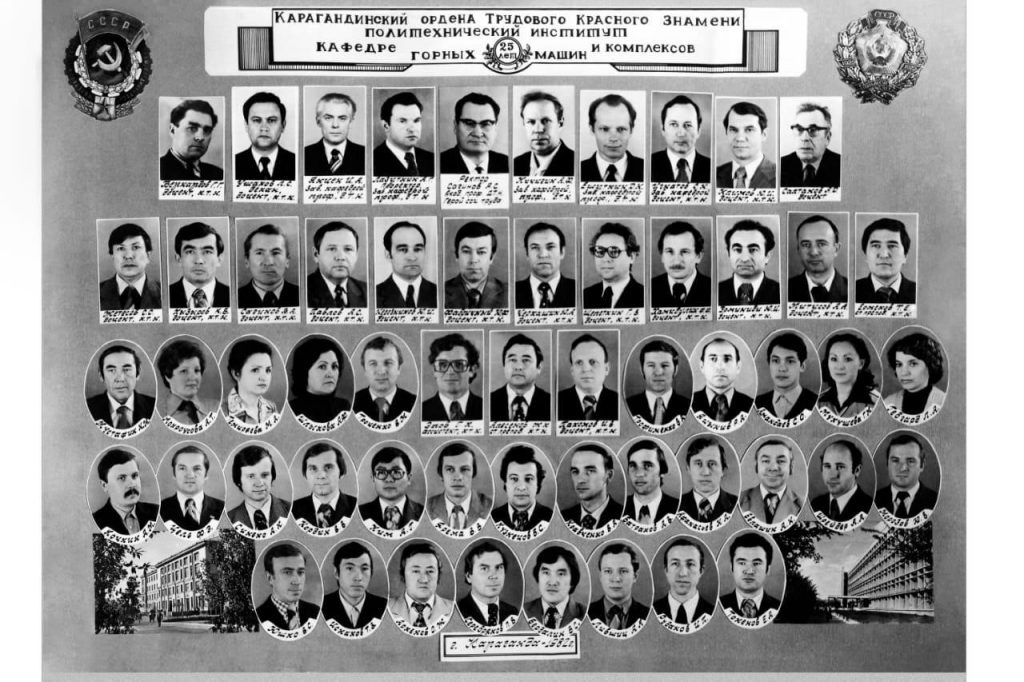
1982, Department of Mining Machines
Department of MiningMachines and Equipment» was founded in 1957. The first head of the department was the rector A.S. Saginov, and the department consisted of the following staff: associate professors I.K. Khrustalev. A.M. Epshtein; senior lecturers A.F. Kichigin. V.Ya. Daubert; assistants D.M. Belenkiy, Yu.N. Kazak. In 1958, the department became a graduating department and the first student intake took place for the specialty «Mining Machines and Complexes». The department was headed by A.F. Kichigin (professor, doctor of technical sciences), and in 1971 he was replaced by A.G. Lazutkin. – later Doctor of Technical Sciences, Corresponding Member of the Academy of Sciences of the Kazakh SSR, Rector of KarPTI (1987–1993)
The main objective of the department during its first period of operation was to form a teaching staff, primarily from among the department’s graduates, as well as from other universities in the country. Many of them subsequently became scientists and teachers (professors D. N. Yeshutkin, Yu. I. Klimov, A. S. Pavlov, L. S. Ushakov, Yu. A. Cherkashin, associate professors A. A. Mitusov, Yu.I. Neroznikov, Yu.F. Fabrichny, and others).
In the 1960s, the department defined its core research focus on the research and development of fundamentally new mining equipment. This work was carried out under business contracts with enterprises in the Karaganda region, as well as scientific and industrial centers across the Soviet Union. Specialists from the Karaganda Coal Research Institute (KNIUI), the Karaganda Coal Engineering Design Institute “Giprouglegormash,” the Karagandaugol and Karagandashakhtostroy combines, and the Kargormash and RGSHO plants, among others, participated in the research. Experimental and pilot models of new mining equipment for the mechanization of tunneling and production operations were introduced into production. The following were established: a problem-solving laboratory on the “Scientific Foundations of Hydropneumatic Pulse Systems for the Destruction of Rocks and Permafrost”; a laboratory on the “Integrated Mechanization of Preparatory Work in Mine Construction”; a laboratory on “New Methods and Means for Developing Coal Seams with Complex Conditions,” and others.
From 1992 to 1994, the department was headed by Professor L.S. Ushakov, Doctor of Engineering. This period was associated with the first years of the Republic of Kazakhstan’s independence, the breakdown of economic and scientific ties, meager budget funding, and the outflow of students from technical universities.
From 1994 to 2008, the department, under the direction of Yu. I. Klimov, focused on the development and implementation of computer technology and automation tools into the educational process.
Over the years, the department was headed by: Doctor of Technical Sciences, Professor Kuanyshbaev Zh.M. (2009–2010), Candidate of Technical Sciences, Associate Professor Malybaev N.S. (2010–2014), Candidate of Technical Sciences, Associate Professor Zholdybaeva G.S. (2014–2015).
The Department of Mining Machinery and Equipment has trained more than 2,300 mining engineers and mechanics, 50 candidates and 17 doctors of science, 140 bachelors in technological machines and equipment, and 18 masters of engineering and technology.
On the basis of the Department of Mining Machinery and Equipment, the Department of Industrial Transport (1964) and the Department of Construction and Road Machinery (1968) were created.
The department has repeatedly organized all-Union and international scientific and technical conferences with the participation of scientists from leading universities.
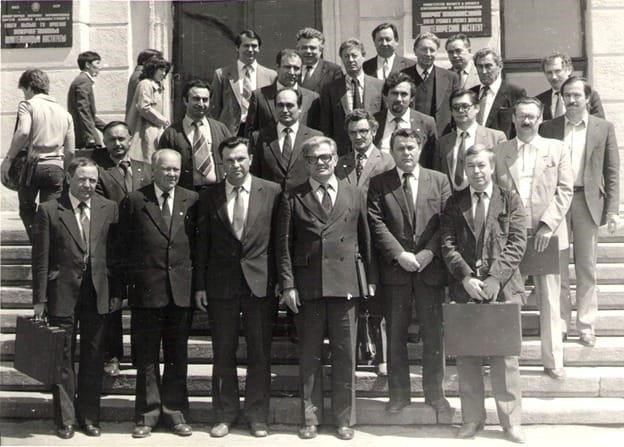
Participants of the international conference “Impls – 90” in
Karaganda, KPTI
The Department of Mechanical Engineering Technology was established in 1961.
The first intake of 25 students in the specialty “Mechanical Engineering Technology, Metal-Cutting Machines and Tools” was carried out in 1959.
To develop the specialty, the rector’s office and faculty conducted extensive work to attract qualified teaching staff from leading universities and advanced mechanical engineering enterprises of the USSR. In the early years, leading specialists from central universities were widely recruited: G.I. Solod, Doctor of Engineering, Professor, Moscow Mining Academy; G.N. Sakharov, Doctor of Engineering, Professor, Stalin Prize laureate; A.A. Borovoy, Doctor of Engineering, Professor; Yu.L. Arbuzov, Doctor of Engineering, Professor, Moscow Machine Tool Institute.
In August 1961, A.V. Ettel, who had served as chief technologist at the Lyubertsy Agricultural Machinery Plant, was invited to join the Department of Metals Technology and promoted to associate professor. He headed the new Department of Mechanical Engineering Technology. From this time on, the department’s development began. The first faculty members were Ya.P. Kim, S.V. Starukhin, V.A. Kleshchin, E.V. Kleshchina, and I.L. Belostotskaya.
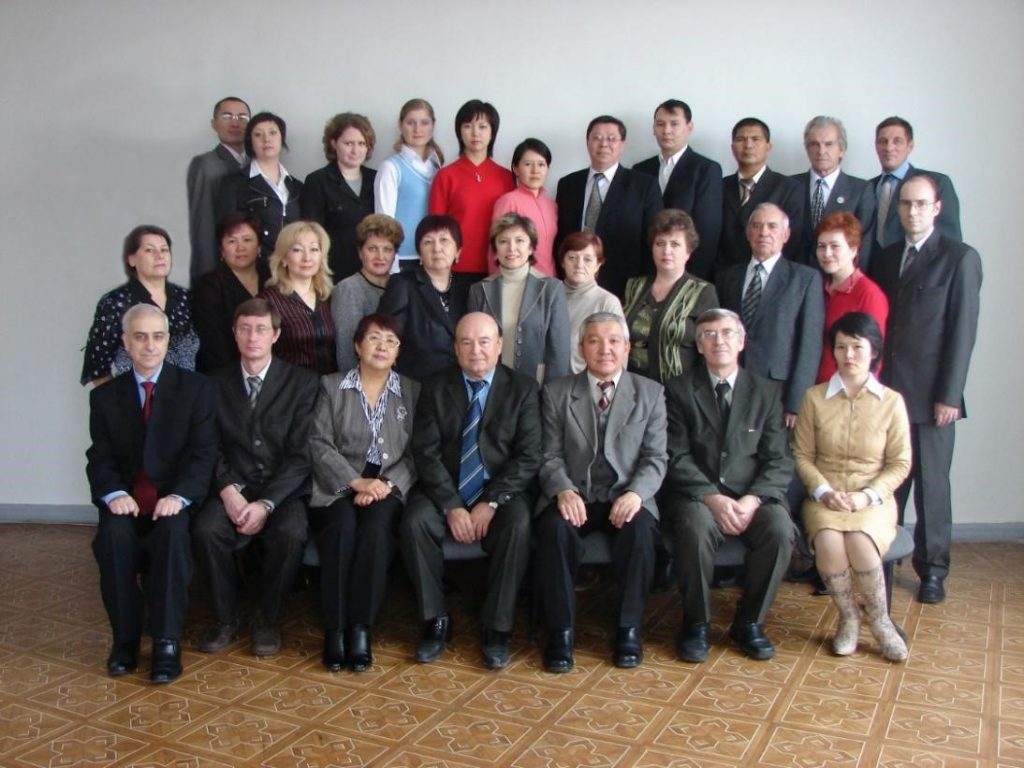
Department of Mechanical Engineering Technology, 2010
The primary objective of that period was to staff the department’s faculty. This was accomplished by recruiting graduate students from central universities across the country: M.S. Nerubay from the Kuibyshev Polytechnic Institute, and L.A. Ushomirskaya from the Leningrad Polytechnic Institute.
The best graduates of the first cohort were sent to targeted postgraduate programs at leading universities in the USSR: A.P. Churikov, A.M. Akzholov, and Ya.P. Kim were sent to the Moscow Machine Tool Institute; S.M. Abilova was sent to the Tula Polytechnic Institute; V.A. Bauman was sent to the Bryansk Institute of Transport Engineering; V.G. Gusev was sent to the Bauman Moscow State Technical University; and A.E. Bengard was sent to the Leningrad Polytechnic Institute. All of them successfully defended their candidate dissertations and became associate professors in the department.
The following teachers of the department prepared and successfully defended their candidate dissertations: Starukhin S.V., Fekh E.A., Makeev V.F., Padiarova I.P., Tumenov T.N., Olshtynsky P.V., Shvoev V.F., Oteniy Ya.N., Podtikhova L.N., Muravyov O.P., Sikhimbaev M.R. and the doctoral dissertation of Gusev V.G.
Many of the graduates have become prominent executives and scientists both in the Republic of Kazakhstan and abroad: S. O. Titkov, Doctor of Sciences, leading CAD specialist (Toronto, Canada); E. A. Fekh, Doctor of Sciences (Germany); V. G. Gusev, Doctor of Technical Sciences, Professor (Germany); G. A. Yantzer, graduate of the Academy of World Economy; S. A. Zhakenov, Chief Engineer of Kargormash CJSC; V. V. Kurenkov, Deputy Director of KLMZ; V. V. Petrov, Deputy Director for Production of RGTO; T. N. Tumenov, Candidate of Technical Sciences, Associate Professor, Director of BelRosinstrument, etc.
As the department developed, new specialties began to emerge. In 1970, the first intake for the “Mechanical Engineering” specialty was admitted, with graduates receiving the qualification of “engineer-teacher.” The creation of this specialty was prompted by a shortage of specialists in the vocational education system, which provided workers for mechanical engineering companies.
In 1994, in connection with the opening of the specialty “Metal-cutting machines”, the department was divided into two: “Mechanical Engineering Technology” and “Metal-cutting machines”, but in 1996 the departments were reunited.
In 1997, the department opened a new specialty, “Standardization and Certification,” for the first time in Kazakhstan.
Since its inception, the Department of Mechanical Engineering Technology has trained more than 2,300 specialists working in various regions of Kazakhstan, the CIS countries, and abroad.
In different years the department was headed by: Ignatov S.N. (1971 – 1983) – candidate of technical sciences, professor, Piven G.G., (1983 – 1993) – doctor of technical sciences, professor, Olshtynsky P.V., (1994 – 1997) – candidate of technical sciences, associate professor,Shvoev V.F. (1997–2008) – PhD, Professor, Zhetesova G.S. (2008–2014) – DSc, Professor, Sherov K.T. (2014–2015) – DSc, Professor.
Shvoev V.F. took an active part in the work of the center for forecasting in the field of mechanical engineering, was one of the developers of quality management systems for universities of the Republic of Kazakhstan, a new generation of state educational standards for the specialties of mechanical engineering, standardization, metrology and certification.
In 2017, the Department of TEMEaS included the Department of “Equipment and technology for welding production”
The Welding Department was established in 1965. It was the first department of its kind in Kazakhstan. The department was headed by Academician of the Kazakh SSR Academy of Sciences, Doctor of Engineering, and Professor V.K. Gruzinov.
The first teachers of the department were graduates of the Ural Polytechnic Institute: V.V. Petrovsky, N.L. Osintseva and K.B. Sysoev.
First set the first batch of students majoring in “Welding Equipment and Technology” began in 1963. The groups consisted primarily of former production workers with experience in the field. The first graduating class of engineers majoring in “Welding Equipment and Technology” in Kazakhstan took place in June 1968, with 12 students. From this graduating class, Zh.E. Abilov was assigned to work as a lecturer in the department.
In 1968, the Department was headed by VS Sidoryuk, a candidate of technical sciences who had previously worked as a chief welder at the Dnepropetrovsk metal structures plant.
In 1969, the department was expanded with another candidate of science: after completing postgraduate studies and defending his dissertation at the Gubkin Moscow Institute of Oil and Gas, V. I. Bochenin was hired. In 1970, M. T. Akhmetbekov, A. N. Davidovsky, and V. P. Enin, from the graduating class of welding engineers, were retained at the department. Since 1970, the department began to carry out contractual research and development with enterprises in the region.
These research projects became the foundation for the development of the department’s scientific direction. The scientific supervisors of the work were Candidates of Technical Sciences, Associate Professors V.S. Sidoryuk and V.I. Bochenin, and the responsible executors were senior lecturers K.B. Sysoev, V.V. Petrovsky, and N.L. Osintseva. From 1970 to 1973, the department was replenished with full-time employees of the institute’s research sector: A.N. Davidovsky, I.A. Bartenev, and T.G. Shigaev.
Since 1974, the department has been headed by V.A. Danilov. Gradually, the department expanded, strengthening its material and technical resources. Student enrollment increased to 100.
In 1982, F. A. Wagner, invited from the Moscow Institute VNII Montazhspetsstroy, was appointed head of the department. In 1984, the welding department was merged with the department of “Foundry Production and Technology of Structural Materials.” This department was called “Technology of Welding and Structural Materials”, and Doctor of Engineering Sciences, Professor V. I. Bochenin, was appointed head. In 1986, the department was reverted to its original name of “Equipment and Technology of Welding Production,” and Candidate of Engineering Sciences, Associate Professor T. G. Shigaev was elected head.
In December 1991, the Association of Welders of Central Asia and Kazakhstan was formed.
In April 1998, the Non-Destructive Testing Certification Center (NDTC) was established at the department, which is engaged in the training, certification, and recertification of specialists in various non-destructive testing methods.
In 2000, renovation of the department’s laboratory began. A laboratory for non-destructive testing of welded joints was built and equipped with the latest teaching aids and instruments, and high-tech welding equipment is widely used in the teaching process.
Among the graduates of the department are Marinushkin B.M., General Director of Almatyenergo, Zhuravlev N.I., Technical Director of JSC Kargormash-Itex, Akhmetzhanov N.K., Chief Welder of JSC Kazkhimmontazh, R.A. Rakhmatullin, Chief Welder of JSC Imstalkon, Goncharova R.D. – Associate Professor of Bauman Moscow State Technical University.
With the active participation of the department’s staff, nine national scientific and technical conferences on welding and quality control and two national welding competitions were organized. The first National NDT Detector Competition was held in June 2002.
The department was the only developer of the 1st and 2nd generations of state standards for higher professional education in the specialty “Equipment and technology of welding production”.
The TEMEaS Department has two research schools, led by Doctor of Engineering, Professor G.S. Zhetesova (Resource-Saving Technologies for Component Restoration) and Doctor of Engineering, Associate Professor K.M. Beisembaev (Design and Construction of Mining Machinery and Equipment). Since its inception, these schools have trained three candidates of engineering sciences, eight PhDs, and over 100 master’s degree students.
Within the framework of scientific schools, projects are carried out with grant funding, as well as research work in problematic and innovative areas.
For many years, the department has been cooperating with Vilnius Gediminas Technical University (Lithuania), Tomsk Polytechnic University, Peter the Great St. Petersburg Polytechnic University and NUST MISIS (Russia), Yanka Kupala State University of Grodno (Belarus), Berlin Technical University (Germany), and Poznan University of Technology (Poland).
The department has production ties with the enterprises of the innovative and educational consortium “Corporate University”: KLMZ TOO “Maker”, OJSC “Minsk Tractor Plant”, TOO “KZMK-IMSTALKON”, TOO “EPIROC” Central Asia, OJSC AMT mine Kazakhstan, JSC “ArcelorMittal Temirtau”, TOO “ADS company”, TOO “Bemer Armature of Kazakhstan”, TOO KF “Ganza Flex Hydraulic Almaty”.
During the existence of the department, its teachers have more than once been awarded the title “Best Teacher” by the Ministry of Education and Science of the Republic of Kazakhstan: 2011 – Zhetesova G.S.; 2012 – Sherov K.T.; 2013 – Erakhtina I.I.; 2014 – Zharkevich O.M.; 2019 – Yurchenko V.V., 2020 – Nikonova T.Yu., Buzauova T.M.; 2021 – Musaev M.M.
The department’s staff are the authors of several generations of state educational standards in the areas of “Mechanical Engineering”, “Technological Machines and Equipment”, “Standardization and Certification” and standard curricula for compulsory disciplines.
The educational programs have been internationally accredited by Acquin and the National Association of Arbitration Arbitration (NAAR) and annually occupy 1st and 2nd places in the Atameken rating.
The contingent of students in the department’s educational programs is more than 500 students for the bachelor’s degree, more than 40 people for the master’s degree, and 12 people for the doctoral program.
Students of the department annually win prizes in Olympiads held in the Republic of Kazakhstan and neighboring countries.